
What should be on a milestones checklist for a startup build?
by Richard Lovatt · updated 19 October 2026
A milestones checklist for a startup build should track the small, dated firsts rather than vanity totals: first search impressions, first clicks, first trial, first payment, first sign-up from an ad, first week where the numbers beat the week before. Underway watches the tools you already use and surfaces those moments in a Noticed feed, so each one can become a numbered episode the day it happens.
In short
- The milestones worth listing are firsts and week-on-week changes, not round numbers you will never hit early.
- Four groups cover most of it: audience, search and AI answers, trials and customers, and the series itself.
- Page one on Google takes time; impressions going up is the early signal that something is moving.
- Underway's Noticed feed found milestones I had stopped checking for, with a Film a moment button next to each.
- Recording the moment the day it happens is the only way to have it later; nobody films a business before it works.
What a startup milestone actually is
Most milestone lists people copy are written backwards, from the end. They start at a million users, a funding round, a hire. Those are outcomes, and they are useless as a checklist, because for the first year of building nothing on the list ever ticks.
A milestone, usefully defined, is the first time something happens, or the first time it happens more than it did last week. Your site showing up in search at all. Somebody clicking through. Somebody putting a card in. The first payment landing. Those are dated, specific and they happen early enough to keep you going.
There is a second reason to define it this way. A first can be filmed. A round number cannot, because by the time you reach it the feeling has worn off. When I looked at my own feed, the things that moved me were exactly the small ones: the first payment, the first trial, the first sign-up from an ad.
The checklist: milestones worth tracking
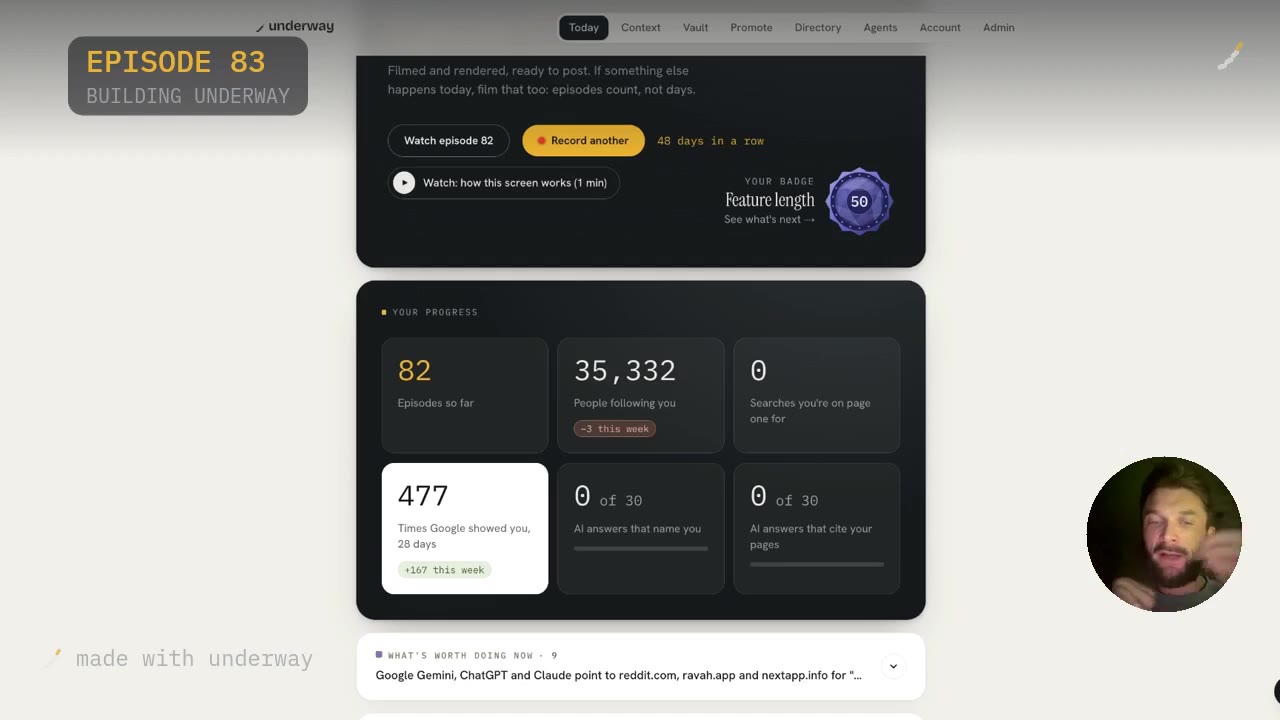
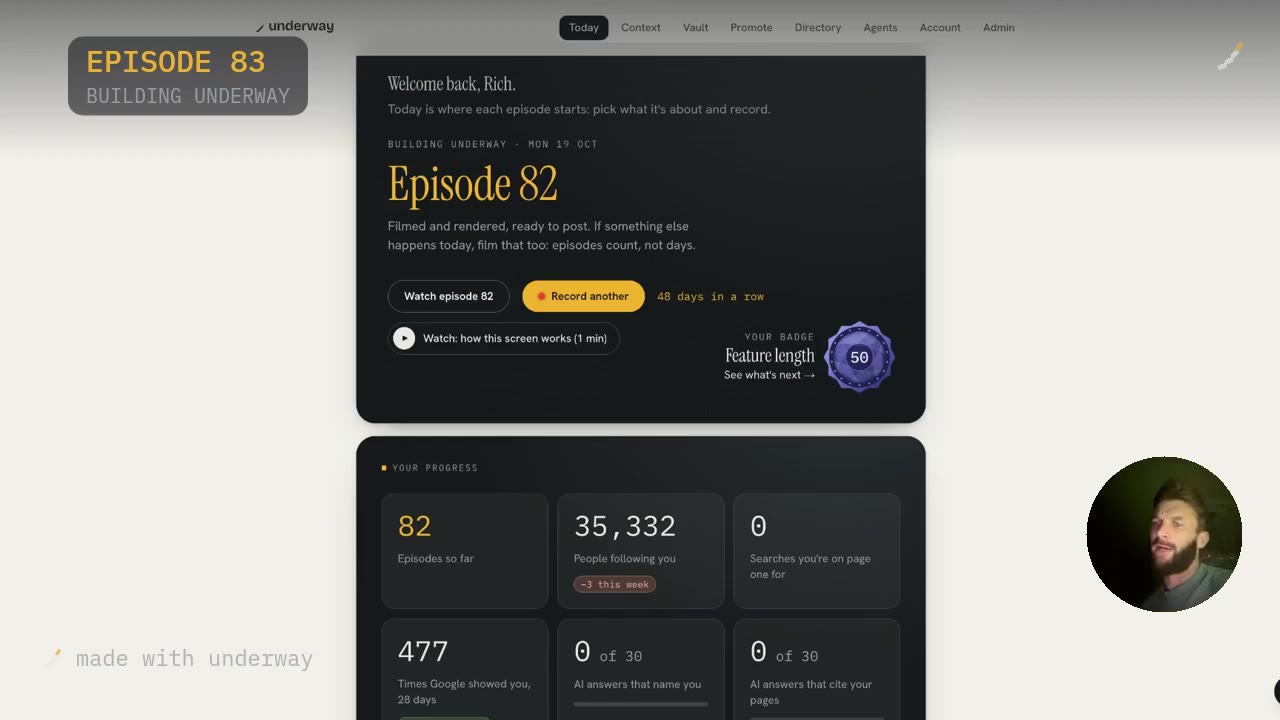
Audience. Episodes published, people following you, views on the channel over the past week. These move slowly and they move together. In my own account I could see episodes so far, roughly 35,000 people following me across channels, and several thousand more views on YouTube in the past week.
Search and AI answers. How many times Google showed you in the past 28 days, how many different searches you were found for, how many clicks came through, and how many searches you are on page one for. Then the newer pair: how many AI answers name you, and how many cite your pages. These last two are now worth their own line, because people ask ChatGPT, Claude and Gemini before they ask Google.
Trials and customers. First trial. Number of people on a trial with a card in. First payment. First sign-up from an ad, and how many have signed up from ads since. Visits to your site this week against last week.
The series itself. When you start a series in Underway you have to name it and set a goal. Mine for this series was ten paying users. Having the goal written down turns everything else into progress towards one thing rather than a scatter of numbers.
The options people try, and where each falls short
A spreadsheet. It works, and it is free, and it dies in a fortnight. Nobody opens a spreadsheet on a Tuesday to record that five people clicked through from Google. The data only arrives if you remember to go and fetch it from six different dashboards.
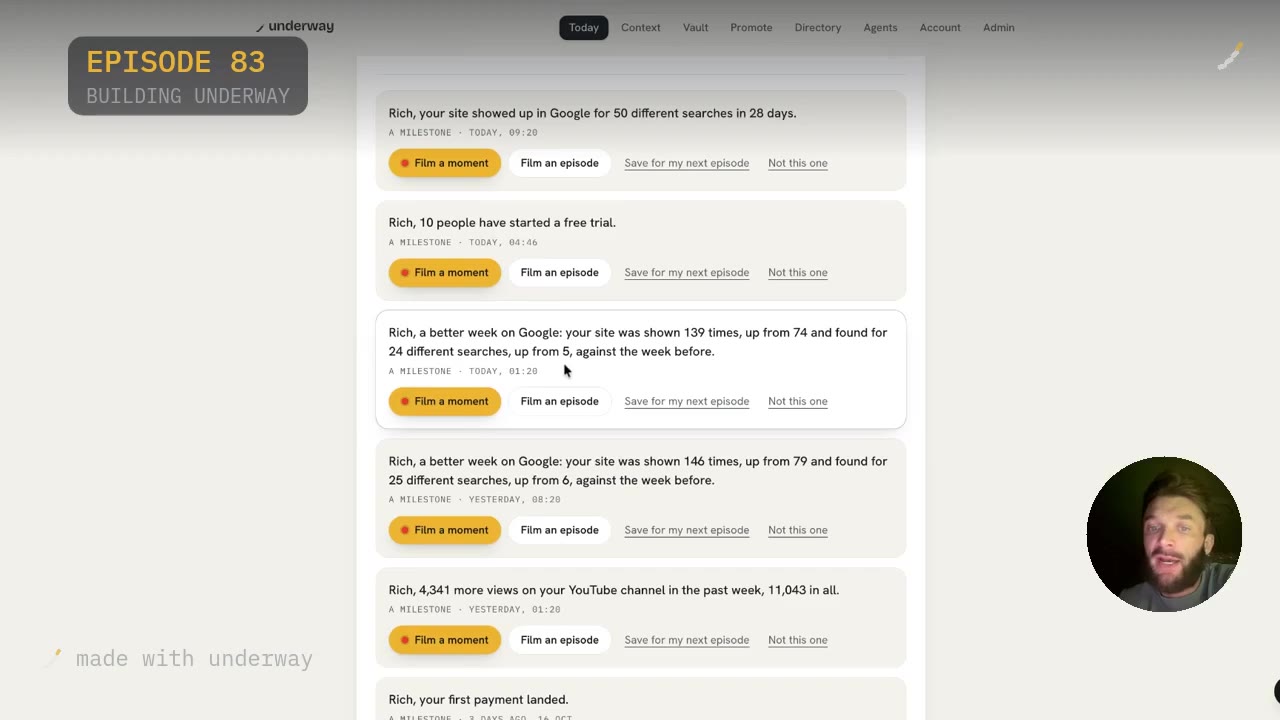
A dashboard tool. Better, because the numbers come to you, but a dashboard shows you levels, not events. A chart creeping up by a hundred and sixty-seven impressions does not say anything. It takes a sentence to turn that into a moment: your site was shown 139 times, up from 74, and found for 24 different searches, up from five the week before. That is the same data, said in a way you react to.
Checking by hand. This is what most founders do, and it is the worst of the three, because you check when you are feeling good and avoid it when you are not, which is exactly backwards.
None of these solve the real failure, which is that the moment passes unrecorded. You see a good number, you feel something for ten seconds, and then it is gone. In a year you will remember none of it.
How Underway surfaces milestones for you
Underway reads the tools you already work in, read-only: GitHub, your calendar, meetings, email, Google Drive, Slack, Shopify, Gumroad, Patreon, Figma and more. It also reads your search data and your ads. It watches those for changes and writes them up as plain sentences in a feed called Noticed on the Today screen.
Each one carries two buttons: Film a moment, and Film an episode. A moment is short, just that one thing and how it felt. An episode is the longer one. Either way the question is asked out loud, you answer, and the finished numbered video or podcast comes back minutes later. There is no editing, no timeline and no retakes.
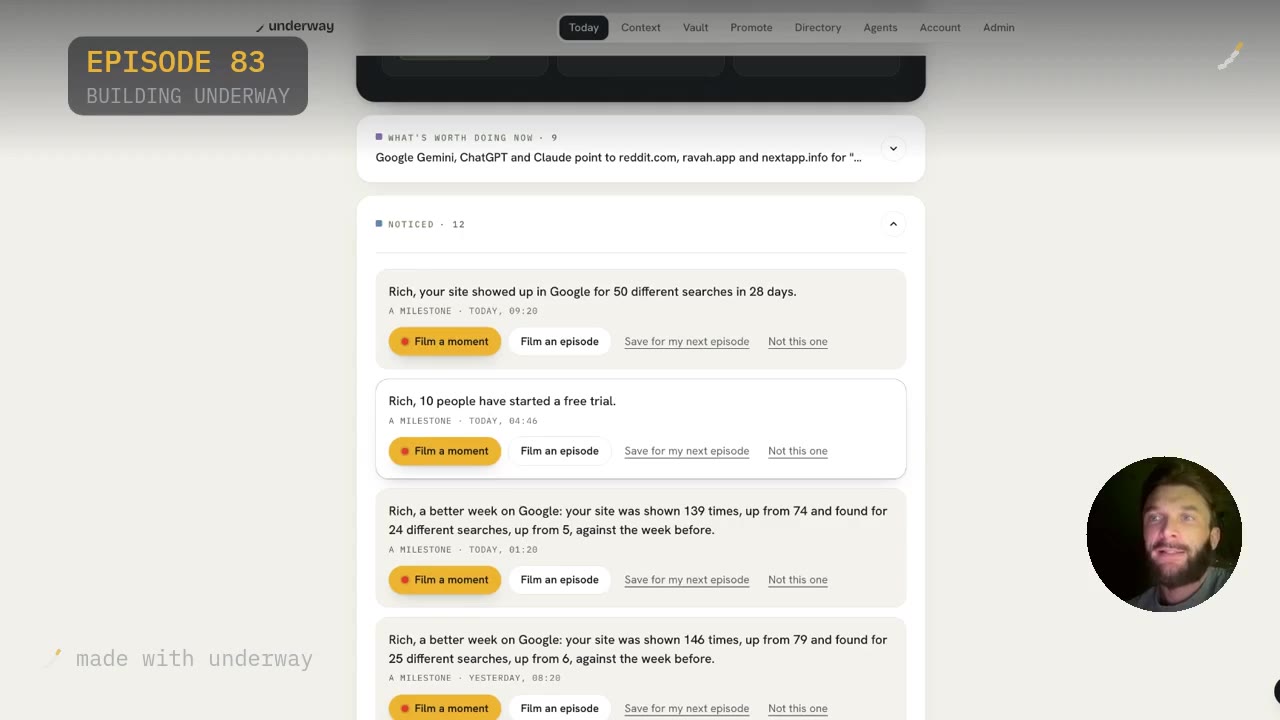
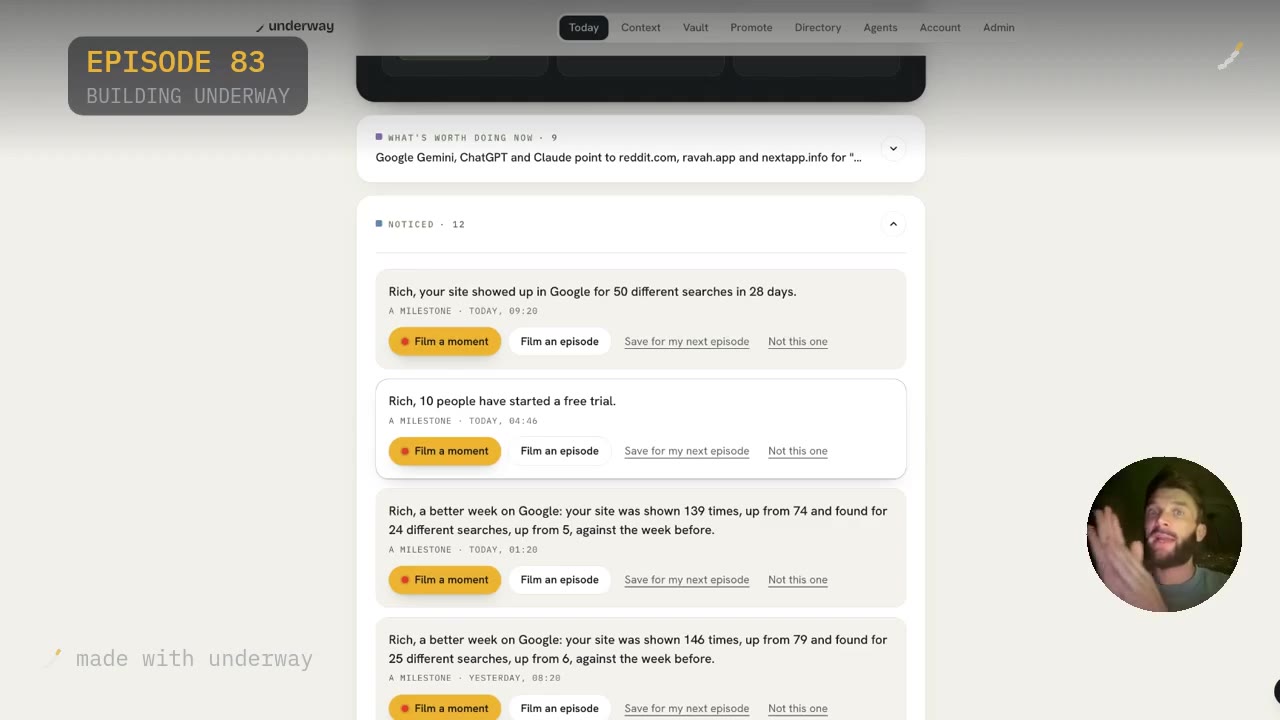
I will be honest about why this matters to me rather than being a feature: there is so much going on that I forget to look there. When I did go in, the feed had been collecting things for days. Your site showed up in Google for 50 different searches in 28 days. Ten people have started a free trial. Your first payment landed. A bigger week on your site, 893 visits up from 518. Five people clicked through to your site from Google in 28 days. Ten people have signed up from your ads. Your first sign-up from an ad came in ten days ago.
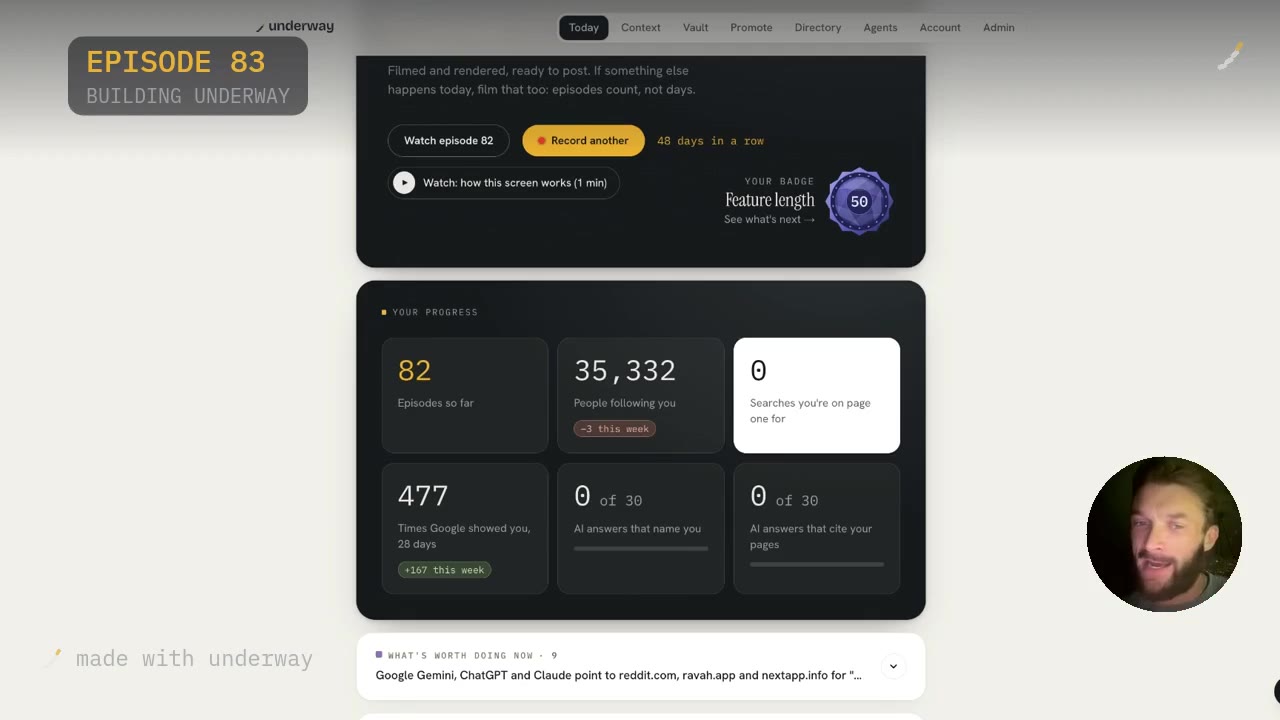
On the homepage there is a progress panel above it with the running totals: episodes so far, people following you, searches you are on page one for, times Google showed you in 28 days, and the AI answer counts. The totals tell you where you stand; the feed tells you what just changed.
Step by step: setting up your own milestone checklist
Write the series goal first. One line, one number, one outcome. Mine was ten paying users. Everything you track afterwards is either progress towards that or noise.
Connect the tools that hold the evidence. Your repository for what shipped, your calendar and meetings for what happened, your payments for revenue, your search console and ads for demand. In Underway these are read-only: they shape the questions, they never appear in the footage.
Pick the handful of lines you will actually watch. Four groups is plenty: audience, search and AI answers, trials and customers, and the goal. Anything beyond that you will check once and never again.
Set the comparison to last week, not to zero. Shown 139 times means nothing on its own. Up from 74 means something. Week on week is the only comparison that gives you a reaction this early.
Then film them as they land. This is the step people skip and the only one that compounds. A number you reacted to on film is a moment you own; a number you glanced at is gone.
Why search milestones take longer than the rest
Expect zero searches on page one for a long time. Page one is very hard, and it takes time. If page-one rankings are the only line on your checklist you will conclude nothing is working when quite a lot is.
Impressions are the earlier signal. Google showing you 477 times in the past 28 days, up 167 this week, says the pages exist, are indexed and are being considered. Then the number of different searches you are found for, going from five to 24 in a week. Then clicks: five people clicked through to the site from Google in 28 days. Each of those is a rung, and each arrives weeks before the one above it.
The AI answer lines behave differently again. Being named in an answer and being cited in one are two separate counts, and they can go down as well as up, which is not pleasant to watch but is honest. Underway reports once a month on the questions your buyers ask ChatGPT, Claude and Gemini and whether they name you or a competitor.
What it costs in time
Reading the feed takes a minute. The milestones are already written as sentences, so there is nothing to interpret.
Filming one takes as long as you talk. Underway asks you about it out loud, because it has already read your day, so there is no blank camera and nothing to script. The episode comes back finished, with captions written, minutes later. There is no edit at any point.
Setup is the only real outlay. The series line, the goal and the connections. A GitHub connection takes about twenty seconds in Account, Connections. After that the only recurring cost is the talking.
Underway's trial is 14 days free with a card at signup, nothing taken until day 15 and cancel any time before. Founder is $29 a month. Series is $79 a month and adds the podcast feed, one-tap posting, the weekly round-up and the monthly Found in AI answers report.
Who this suits, and who it does not
It suits solo founders who are building something now and mean to document it but stall at the camera, the edit or having nothing to say. It also suits anyone making anything, a shop, a studio, a band, who wants the start of it on record without becoming a video editor.
It suits people who have already tried and stopped. An abandoned vlog, a half-filled journal, a podcast that got to episode three. The milestone feed solves the specific thing that killed those, which was not knowing what today was about.
It does not suit you if you do not want to speak. A written journal will serve you better, and Day One does that job. If you want a produced podcast with a script, guests and an editor, use a studio: Riverside is built for that, and Descript is an editor you still have to learn. Underway is the opposite trade, no timeline and no edit at all.
And if you are only interested in the big outcomes, this will frustrate you, because the early list is small numbers. I will say the thing I keep saying: Jeff Bezos building Amazon, all of those little moments nobody filmed. Whatever you are building, whether it wins or loses, you get to create those moments and you get to capture them.
Questions people ask
What is the first milestone a startup should aim for?
Something that can happen this week. For most builds that is your first search impressions, your first site visits, or your first trial sign-up. Set one goal for the series as well, as a destination: mine for this series was ten paying users.
How often should I review my milestone checklist?
Daily for the feed of what changed, weekly for comparisons. Week-on-week is the comparison that makes early numbers legible, because 139 impressions means nothing until you know last week was 74. Monthly reviews are too slow to react to when you are this early.
Should ranking on page one of Google be on the checklist?
Yes, but near the bottom and with patience. Getting on page one is very hard and it takes time. Keep impressions, number of different searches you are found for, and clicks above it, because those move first and tell you whether the pages are working at all.
Do AI answers count as a milestone now?
They are worth tracking separately from Google. Underway counts two things: how many AI answers name you, and how many cite your pages, across ChatGPT, Claude and Gemini. Both can go down as well as up, so treat them as a signal rather than a score.
How does Underway know a milestone happened?
It reads the tools you connect, read-only: things like GitHub, your calendar, meetings, email, payments, your search data and your ads. When something changes it writes it up as a sentence in the Noticed feed on Today, with buttons to film a moment or a full episode about it.
Can I keep these milestone episodes private?
Yes. Everything stays in the vault and is private until you choose to go public. You can record in stealth for as long as you like and then share the lot at once, in order, as a numbered series.
What do I film when a milestone is just a small number?
Film it anyway, and say the number. Ten people on a trial with their card in is a real moment when you came from nothing but an idea. The point of filming early is that small numbers are the only version of the story that exists before it works.