
Article
how to interview yourself for a podcast (and not ramble)
30 September 2026 · 10 min read
Post on Xhow to interview yourself for a podcast: the short answer
how to interview yourself for a podcast, in one line: write the questions before you record, have something other than your own head ask them out loud, answer each one as if a person asked it, and keep the question audio in the finished episode.
that last step is the one people skip, and it is the one that matters. a solo episode with the questions cut out is a voice note. with the questions left in, it is two voices, a question and an answer, and the listener hears an interview.
most guides on page one are about interviewing guests. this one is about the episode where there is no guest, just you and a microphone, and how to make it sound like someone was across the table.
why a solo episode sounds like a monologue
you sit down with a topic and start talking. by minute four you have said the main thing twice, wandered into a tangent, and started a sentence with "so anyway". nobody is there to stop you, so nothing does.
an interviewer does three jobs you cannot do from inside your own head:
- they choose what gets talked about next, so you are not planning and answering at once.
- they ask about the specific thing, the number, the name, the call, so the answer has something concrete in it.
- they end the section. a question is a boundary. without one, every answer runs into the next.
a self interview podcast gives you those three jobs back. you do the choosing ahead of time, when you are calm and can think about structure. then, when you record, you only have one job: answer.
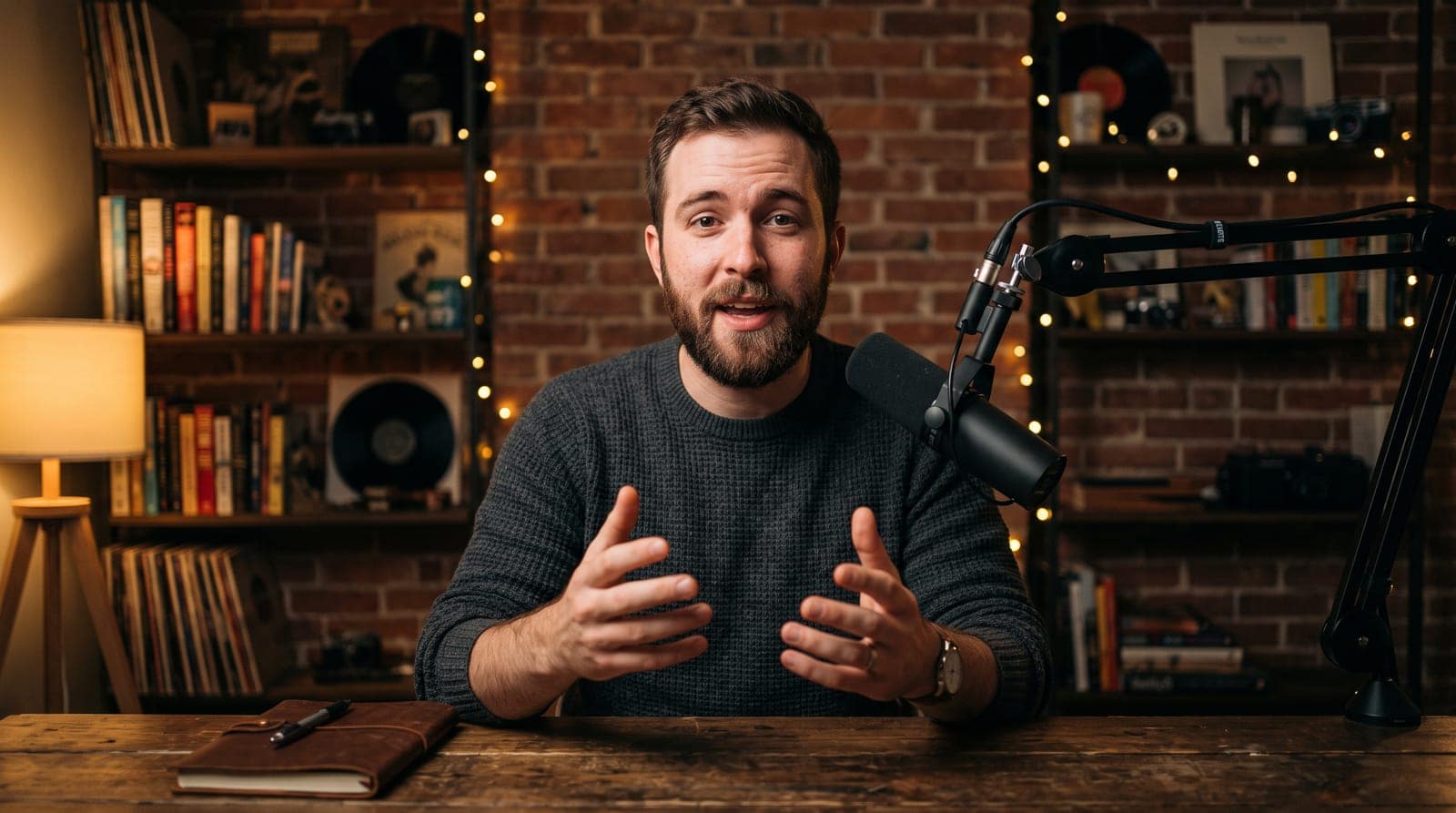
how to write the questions for a self interview
the questions are the whole trick, so spend the ten minutes on them. two rules do most of the work.
first, follow a shape. an episode that works has a beginning, a middle and a way out. the shape underway uses for a daily episode is five beats, and it works for almost any business owner talking about their own work:
- start: where things stood when this began. "what was the state of the checkout page on monday morning?"
- work: what you actually did. "what did you change on the checkout page this week?"
- problem: what went wrong or pushed back. "what broke when the new checkout went live?"
- resolution: what happened to the problem. "how did you get payments working again, and what did it cost?"
- forward: what this changes next. "what are you doing about checkout before friday?"
the forward beat is the one to protect. an episode that digs beautifully into the problem and never reaches what happens next leaves the listener hanging in the wrong way. land it every time.
second, write questions that name their subject. "how did today go?" gets a shrug and a pronoun: "yeah, it was fine, it mostly worked." a listener arriving cold has no idea what "it" is. "what's the state of the signup emails today?" gets an answer that starts with the signup emails, which means the first thing anyone hears makes sense on its own.
a few more things that help:
- one thread per episode. a packed week crammed into ten minutes is a list, not a story. pick the one thing and ask about it from five angles.
- ask about something that happened, not an opinion in the abstract. "what did the customer say on thursday's call?" beats "what do customers want?".
- keep each question short. sixteen words is plenty. put the detail in your notes, not in the question.
- never ask yourself to sell. "why is our product great?" invites a landing page read aloud. "who has actually paid, and why them?" invites the truth.
- write one question you would rather not answer. that is usually the episode.
get the questions asked out loud
reading your own question off a screen and then answering it is better than nothing. it is still you performing to a card. a question you hear, in a voice, makes you answer a person, and the difference is audible in the recording. you slow down. you say "well" before the hard part. you sound like yourself.
three ways to do it without any special software:
- record the questions yourself first, in a different register: slower, as a host. play each one back before you answer it.
- ask a co-founder, partner or friend to read them, and record them asking.
- paste the questions into your computer's or phone's built-in read-aloud, which every modern system has in its accessibility settings, and export or record what it says.
wear headphones while the question plays, so your mic records your answer and not the speaker. then answer straight away. do not pause to plan. the point of being asked is that you respond, and a response is what a listener wants.
how to interview yourself for a podcast, step by step
this works with any recorder: your phone's voice memos, a usb mic into Audacity or GarageBand, Riverside, Descript. none of it needs underway.
- pick the one thread for the episode, and write it down in a sentence.
- write five questions on the five beats, each naming its subject.
- turn each question into audio, in your voice as the host, a friend's, or your system's read-aloud. save them as five short files.
- record your answers in one session, headphones on, one question played before each answer. do not stop to redo a sentence; carry on and say it again better.
- in your editor, lay the question clips in front of each answer. cut the false starts and long silences. leave the "um, actually" that shows you thinking.
- add a chapter at each question. the beats are your chapters: start, work, problem, resolution, forward, each titled with the thing it is about.
- level the two voices so the question is not much quieter or louder than you, and export.
the chapters come for free because you wrote the structure before you recorded. listeners who want the problem can jump to it, and the podcast apps that show chapters will show them.

self interview podcast methods compared
| solo talk | read your own questions | questions asked aloud, kept in | a live host that follows up | |
|---|---|---|---|---|
| sounds like | a monologue | a monologue with pauses | an interview, two voices | a conversation, two voices |
| structure | whatever you remember | your list | your list | your beats, plus follow-ups on what you said |
| effort before recording | none | ten minutes of questions | questions, then turning them into audio | none, or a line about the topic |
| effort after recording | heavy trimming | trim, cut your reading | lay questions in, trim, level | depends on the tool |
| follows up on a vague answer | no | no | no | yes |
the manual method gets you to the third column. what it cannot do is follow up. you wrote the questions before you knew what you would say, so when you skate past the number or say "it was fine", nothing asks what the number was.
how underway interviews you for a podcast
underway is an app that does the asking for you, built around a daily numbered episode. the podcast is one of the ways to answer. you pick audio on the setup screen and choose who asks.
- interview: the host asks out loud, in the voice you chose for your series, and waits for you. it says "right" or "mm-hm" when you stop, thinks, and asks the next thing without you pressing anything. say "that's enough for the episode" and it lands the forward question before it lets you go.
- co-host: a live conversation with an AI co-host. interrupt it, wander, come back; it keeps the thread. both voices are recorded as you go.
- a person asks: a co-founder or friend asks instead, in the room or joining by a link, and both voices go in the recording.
the questions are written from what you actually did. you can connect the places your day happens, calendar, GitHub, a meeting recorder, payments, all read-only, or add a note, a voice memo or a screenshot yourself. the host asks about the call that ran long and the fix you shipped, not "how was your week". it also remembers what you said in earlier episodes, so it can pick up the thing you promised to finish by friday.
after each answer it decides what comes next: a follow-up, the next beat, or the end. it only digs when you named something specific and left it unexplained, and it quotes your words back when it does. a standard episode aims for about three minutes of you talking and stops at five. short is about a minute; long runs up to ten.
the episode renders as one levelled audio file with the questions kept in, numbered in your series. it is also drawn as a video, the waveform moving to both voices with captions, so it can go to YouTube and the short-video apps like any other episode. on the series plan, your podcast feed goes to apple podcasts and spotify once you submit it, and the lines of your notes become chapters.
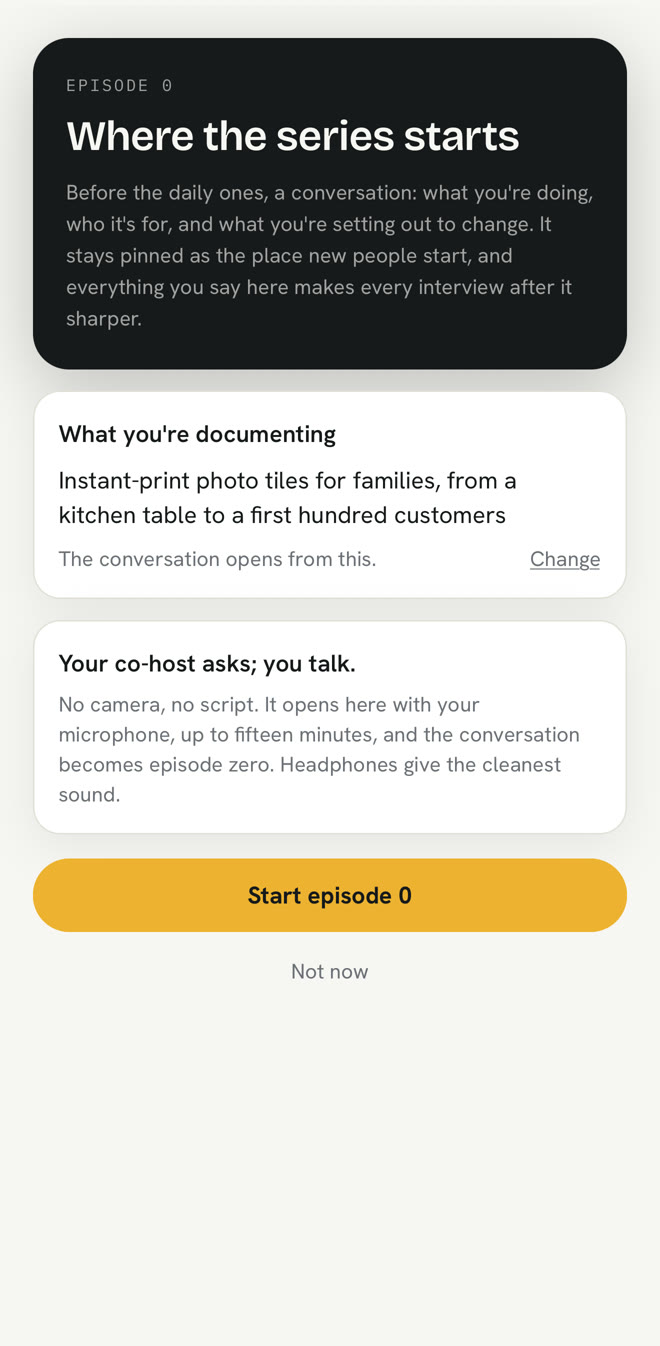
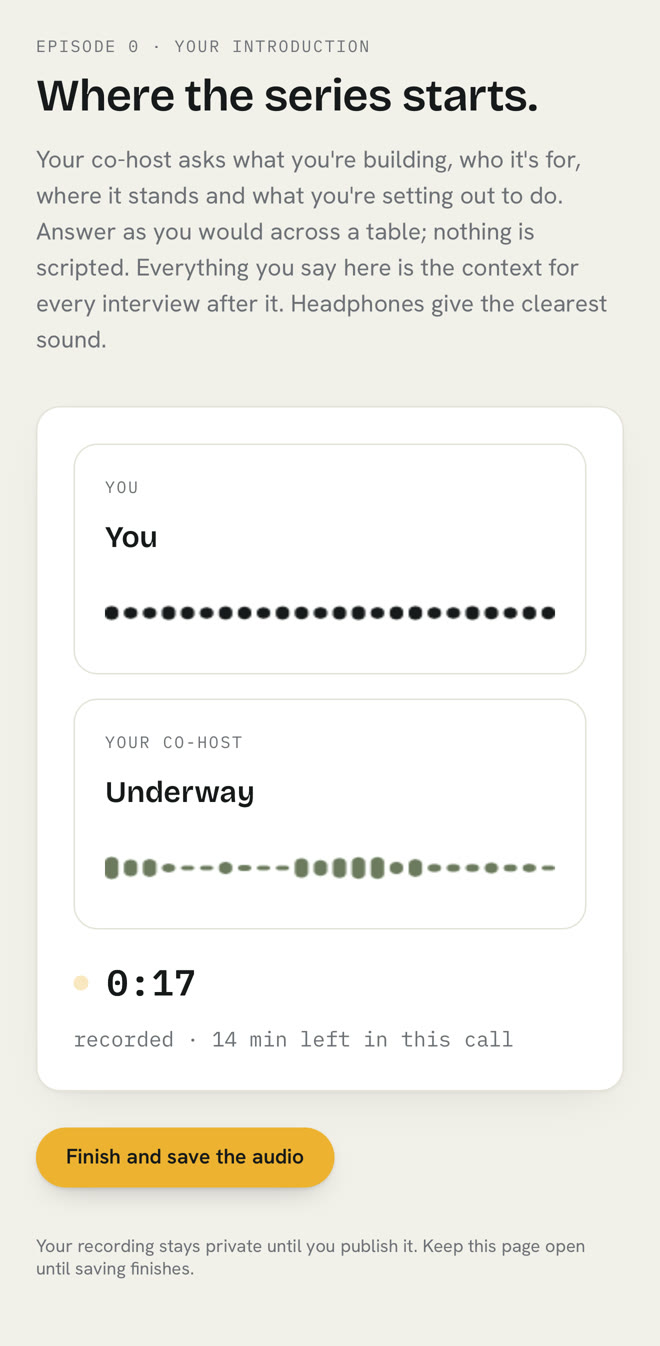
what it costs, plainly. three episodes are free, no card, and the guided interview works on every plan including those. the co-host is metered: an hour a month on founder (£29 a month), three on series (£79 a month), extra hours at £9. episode zero can be a co-host conversation of up to fifteen minutes on any plan. the co-host is for podcasts only; a video episode is you talking to the people watching.
solo podcast ideas for business owners
the best solo episode is about something that happened this week, told in the order it happened. if you are stuck, each of these is one thread for one episode:
- the decision you made this week and what you gave up to make it.
- a customer conversation that changed your mind about something.
- the one number you are watching right now, and why that one.
- the thing that broke, and what it cost to fix.
- a price change: what you charged, what you charge now, and what happened.
- something you stopped doing, and whether anyone noticed.
- a hire, or the reason you have not hired yet.
- a question a customer asked that you could not answer well.
- where the business honestly stands, compared with where you said it would be.
- an intro episode: what you are building, who it is for, what they do instead today, the hardest part, and what you are setting out to do by when.
notice none of these are "five tips for". tips are something you could write. an episode about what happened is something only you can say, and that is why anyone listens to a podcast without a guest.
faqs
can you interview yourself for a podcast?
yes. write the questions ahead of time, have them asked out loud by a recording, a friend or a text-to-speech voice, answer each one, and keep the questions in the edit. it sounds like an interview because it is one.
should i cut my questions out of a self interview podcast?
no. without the questions it is a monologue with gaps. with them it is two voices, and the listener always knows what the next section is about.
how many questions should a solo episode have?
for a short episode, around five: one per beat, start, work, problem, resolution, forward. the clock matters more than the count. stop while you still have something to say.
how do i make a podcast without a guest sound less boring?
one thread per episode, questions about specific things that happened, and a question you would rather not answer. concrete beats clever.
is there an app that interviews you for a podcast?
underway asks you questions out loud from what you actually did, follows up on your answers, and makes a numbered audio episode with the questions kept in. on podcast days you can also talk live with an AI co-host. three episodes are free.
where to go next
the no-camera episode, and how it keeps a series going: /podcast-no-camera.
what to look for in an AI host before you pick one: /ai-podcast-host-that-interviews-you.
questions that work on camera too: /questions-to-answer-on-camera-about-your-business.