
Article
questions to answer on camera about your business
30 September 2026 · 9 min read
Post on Xthe short version
the best questions to answer on camera about your business are about today, not about the business in general. what broke, what shipped, who called, what a number did, what happens next. a question about today has a real answer. a question about your mission has a rehearsed one.
below are fifty of them, grouped by the five beats a working day has: the start, the work, the problem, how it resolved, and what happens next. then a set for your first video, the one that says what the business is. then questions for the days when nothing seemed to happen.
one rule matters more than any single question. the first question has to be written so that the first answer names its subject. "what's the state of the signup emails today?" gets an opening line. "how did today start?" gets a shrug and a pronoun.

why most question lists don't work for a founder
search for questions to answer on camera and you mostly get lists written for someone else. testimonial shoots, where a customer says nice things about a product. photography questionnaires, where a client describes the look they want. interview prep, where a candidate practises for a panel.
those lists share a shape. they ask for a summary. "tell us about your company." "what makes you different?" "why should people choose you?" a founder can answer all of them, which is the problem. the answer already exists, polished, from the last hundred times, and it sounds like it. that is a pitch, and a pitch on camera reads as an advert.
a question about a specific thing that happened in the last few hours can't be answered from memory. you have to think, and thinking on camera is what makes video about a business worth watching. so every question below points at something concrete: a day, a call, a number, a decision.
the cold-open rule: the first answer names its subject
whoever watches your video arrives with no context. if the first sentence is "so it went better than yesterday", they don't know what "it" is, and they're gone. the opening line has to say its subject out loud.
you can fix this in the edit, by hunting for a later sentence that stands alone. it is much easier to fix in the question. people answer in the words they were asked. ask about "the signup emails" and the answer starts with the signup emails. ask "how did today start?" and the answer starts with "well, it".
- weak: "how did today start?" strong: "what's the state of the signup emails today?"
- weak: "any updates?" strong: "where is the checkout redesign this morning?"
- weak: "how's the business?" strong: "what did the first order of the day tell you?"
- weak: "what's new?" strong: "what came out of the call with the supplier?"
only the first question needs this. once the subject is on the table, later questions can say "it" and the viewer keeps up. and none of this means recording an intro to camera. an intro is the moment people start performing. a well-aimed question gets the same opening line without it.
questions to answer on camera about your business, by beat
a working day has a shape: where it started, the work, the thing that went wrong, what you did about it, and what it changes. that skeleton fits a shop, an agency, a clinic or a software product, because it comes from the day and not the trade. pick one or two per beat. swap the bracketed nouns for yours.
the start: questions that open cold
- what's the state of [the signup emails] today?
- where is [the checkout redesign] this morning?
- what did the first customer call of the day tell you about [pricing]?
- which number did you check first today, and what was it?
- what's the one thing [the shop] needs done this week?
- what's at the top of the list today, and why that one?
- who did you hear from this morning that changed the plan?
- what does [the order backlog] look like right now?
the work: what you actually did
- what did the most hours go on today?
- what did you ship, send or finish?
- what did you decide about [the pricing page], and what did you rule out?
- who did you talk to today, and what did they want?
- what's the smallest thing you did today that mattered?
- what did you say no to?
- what did today's work teach you about your customers?
- what would a new hire need to know about how you did [that]?
the problem: what went wrong
- what broke?
- what have you been avoiding this week?
- where did the day go sideways?
- what did a customer complain about, in their words?
- which number went the wrong way?
- what's costing more than you expected?
- what are you acting sure about that you're not sure about?
- what did last week's decision cost you today?
the resolution: what you did about it
- what did you try first, and did it work?
- who helped?
- is it fixed, or patched?
- what did sorting it out cost, in hours or money?
- what would you do differently if it happened again?
- what's still open?
forward: what happens next
- what happens next with [the supplier]?
- what's the first thing you'll do tomorrow?
- what are you waiting on, and from whom?
- what does today change about the plan for the month?
- what would have to be true by friday for this week to count?
- what's the next decision, and when does it have to be made?
always land the forward beat. a video that digs beautifully into a problem and never says what happens next leaves the viewer with nothing to come back for. the forward answer is the reason someone watches the next one.
the first video: questions for an episode zero
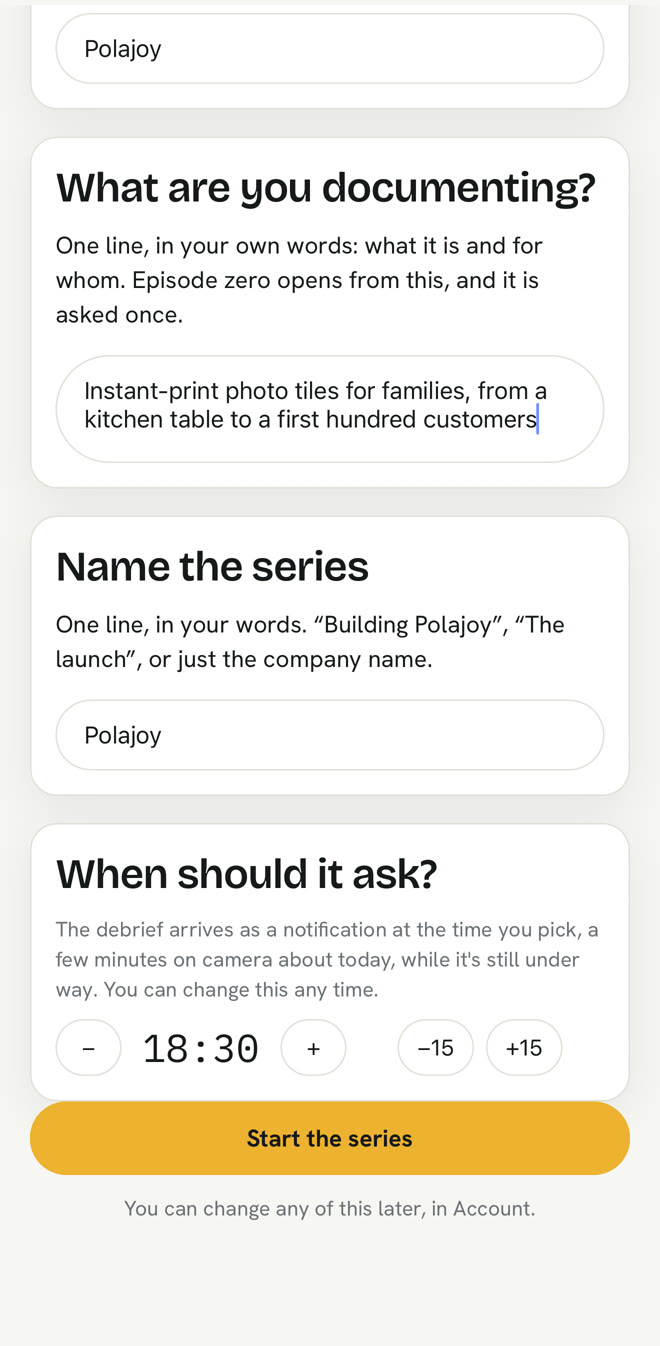
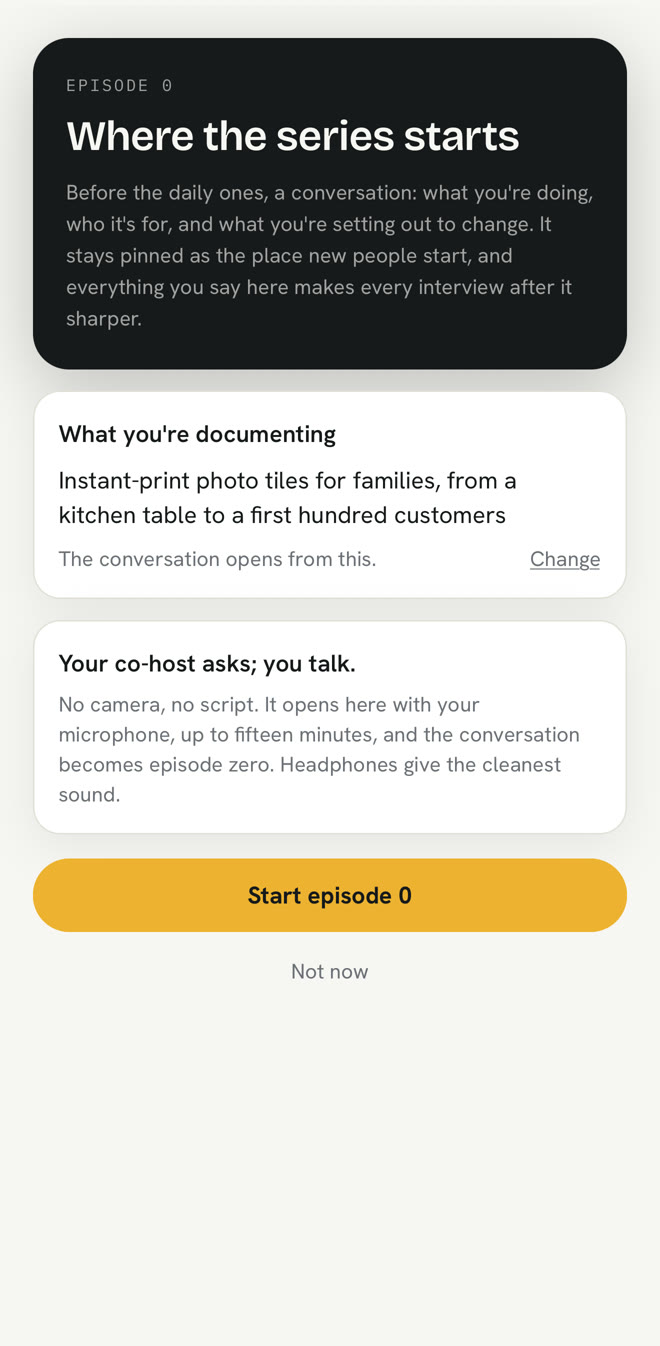
before any daily video, record one that says what the business is. it's the place a new viewer starts, and if you use a tool that remembers, it's the context every later question is asked against. it has six beats. none of them asks you to sell.
- what are you building, in a sentence a customer would recognise?
- who is it for? describe one of them.
- what problem does it solve for them?
- what do those people do instead today?
- where does it honestly stand right now: customers, revenue, or none yet?
- what's the hardest part?
- what are you setting out to do, and by when?
- if the business already exists: what chapter is this, and why now?
the one people skip is "what do those people do instead today?" it's the most useful. it tells a viewer the real competition, which is usually a spreadsheet, a friend, or nothing at all, and it keeps you honest about the size of the problem.
if you've been running for years, the beats don't change, the framing does. "where it stands" carries real scale. "what you're setting out to do" is this season: the rebrand, the raise, ten customers to a hundred. a founder ten years in has more to say here, not less.
questions for a day when nothing happened
most days are not launches. a quiet day is still a day of the business, and it often makes the more honest video. these questions work when there was no deploy, no sale and no drama.
- what did you spend today thinking about rather than doing?
- what didn't happen today that you expected to?
- what did you read or hear that changed your mind about something?
- what's the dull part of the business nobody sees?
- what did you tidy, fix or delete?
- if nothing moved, what's in the way?
questions to leave out
- "tell me about your business." it invites the pitch.
- "what's your mission?" it invites a slogan.
- "why should people buy from you?" that's an advert, and it sounds like one.
- "how did today start?" as an opener. it gets a pronoun.
- two questions in one. the answer takes the easier half.
- any question you already know your answer to, word for word.
how to answer questions on camera about your business
- pick one thread for the video, not five. a packed day in three minutes is unwatchable. one thing followed through its beats is a video.
- three to five questions is plenty: an opener, one or two in the middle, and the forward beat.
- hear the question, then record. if someone reads it to you, they stop talking before you start, so their voice isn't on your answer.
- answer to a person, not a lens. imagine one friend who asked.
- about three minutes of answers in total is a good target. stop while you still have something to say.
- don't restart for a stumble. restart only if you got a fact wrong.
how underway writes these from your day
underway is a founder video diary that works by interview, and this list is roughly what its questions look like. the difference is that it writes them from the day you actually had.
through the day it collects what happened into a tray: your commits, your calendar, what a meeting recorder transcribed, emails you forward to your own address, plus anything you catch yourself, a fifteen-second moment or a freestyle voice note. when you sit down, whenever suits you, it suggests threads from that. you pick one or several, or type your own. it writes one question per pick, plus one to land what happens next.
each question is at most sixteen words, with the detail in a line under it. the first one is written so a natural answer names its subject. you can read them all, change any, and add notes before the camera goes on.
then it asks them out loud, one at a time, in the voice you chose for the series. the question stays on screen too, and asking aloud can be switched off. it asks, then you record, so its voice is never on your answer. after each answer it decides whether to follow up on the specific thing you named and left unexplained, move to the next beat, or stop. on a standard episode it aims for about three minutes of answers and stops at five.
if the tray is empty and you pick nothing, it falls back to standard questions on the five beats, the ones at the top of this page. if you'd rather not be on camera, the same interview runs as a podcast, voice only, questions kept in. three episodes are free, no card.
faqs
how many questions should one video have?
three to five for a short daily video: one that opens cold, one or two on the work or the problem, and one on what happens next. more than that and each answer gets thin.
how long should each answer be?
around thirty seconds to a minute. aim for about three minutes of answers in total and stop before five. the length should come from how much you have to say, not from cutting.
should I write my answers down first?
no. write a few rough lines about the day if it helps you remember, but don't write the answers. a written answer read aloud sounds read.
my business isn't software. do these still work?
yes. the beats come from the day, not the trade. swap "shipped" for "sent", "opened" or "delivered" and a shop, an agency or a clinic has the same start, work, problem, resolution and next step.
what's the best first question for a video about my business?
one that names a specific thing in the question, so the answer names it too. "what's the state of the signup emails today?" rather than "how did today start?"
can someone else ask me the questions?
yes, and it helps. a co-founder or a friend asking makes you answer a person. on underway, a person asks is one of the podcast kinds; on video, the app asks aloud.
where to go next
if the problem is freezing when the camera is on: don't know what to say on camera.
how the interview decides what to ask next: the interview is live, not a form.
for the days that feel empty: what to post when nothing happened.