
Article
ai podcast host that interviews you: what to check first
30 September 2026 · 9 min read
Post on Xan ai podcast host that interviews you: the short answer
an AI podcast host that interviews you is software that asks you questions out loud, listens to your answers and records the conversation as a podcast episode. you supply the knowledge and the voice. it supplies the questions, the structure and someone to talk to.
they are not all the same thing. some read a fixed list of questions in a synthetic voice. some write the list from a topic you type. a few are live: they hear what you said and decide what to ask next. that difference is the first thing to check, because it is the difference between a podcast and a form read aloud.
this page is a buyer's guide. it covers what to check, how the approaches compare, how underway does it, and when underway is the wrong choice.
what an AI podcast host that interviews you actually does
search for this and you get a few small new tools, a lot of lists of AI podcasts to listen to, and sites for booking yourself as a guest on someone else's show. the thing you are looking for is narrower: a host, not a guest-booking service, that interviews you, not one that generates a podcast from a document.
at minimum it should do four jobs a human host does:
- ask one question at a time, out loud, so you answer a voice instead of reading a card.
- wait for you. no talking over your answer, no rushing you to the next thing.
- follow the thread: ask about the number you mentioned, not the next item on its list.
- end the episode, on something that points forward, before you run out of things to say.
everything else, voices, editing, publishing, is secondary. if the interviewing is weak, the episode is weak, however good the audio clean-up is.
scripted question list or a live host that follows up?
this is the biggest difference between tools, and it is easy to test in five minutes.
a scripted host has its questions before you open your mouth. it will ask question three whatever you said in answer to question two. you can hear this in the recording: you say something interesting, and the next question ignores it.
a live host hears the answer and chooses. dig into it, move to the next part, or stop. the good ones have a bar for digging: they only follow up when you named something specific and left it unexplained, or said something that clearly cost you. a host that follows up on everything is as bad as one that follows up on nothing. it feels like being cross-examined, and the episode never gets anywhere.
the test: give a deliberately vague answer with one concrete detail in it. "it was a rough week, the churn number moved and the investor call was odd." a live host asks about the churn number or the call. a scripted one asks its next question.
where do the questions come from?
a host can only ask about what it knows. there are three common sources:
- a template: the same questions for everybody. fine for one episode, dull by the third.
- a topic you type: better, but you still have to decide what the episode is about and type it, which is the part people get stuck on.
- your actual work: your calendar, your commits, your meetings, what you said in the last episode. the host can ask about the call that ran long or the fix you shipped, because it can see them.
ask any tool which of these it uses, and whether it remembers what you said last time. a host with no memory asks you to explain your business every episode. a host with memory can ask whether the thing you promised on tuesday happened.
and if it reads your work, ask what it reads, whether it is read-only, and whether other people's voices from your meetings can end up in the episode. they should not.
one-off episodes or a numbered series?
some tools are built to make one good episode. you give it a topic, it interviews you, you get a file. that is the right shape if you want an occasional episode, or a single interview to cut into clips.
others are built around a series: episode 12 follows episode 11, the host knows what happened in episode 11, and the reason anyone listens is to find out what happened next. that is a different product. it needs numbering, memory across episodes, a feed, and something that makes you come back and record, because a series that stops at episode four is not a series.
decide which you want before comparing features. a great one-off tool is a poor diary, and a diary tool is overkill for a single episode.
whose voice is in the episode?
there are two voices in an interview. the host's is synthetic in every AI tool; that is the point. yours is the question.
some products will generate your side too: clone your voice from a sample and have it read an answer, or produce a whole episode from your notes with nobody actually speaking. that can be useful for some jobs. it is not an interview, and a listener who finds out will not trust the rest of the feed.
if the reason you want a podcast is that people get to know you, check that your answers are your voice, recorded, and that the edit removes pauses and false starts without writing new words. underway never clones or generates the founder's voice. every word of your side of the episode is you, said on the day.
approaches compared
| fixed question list | questions from a topic | live host that follows up | live host that reads your day | |
|---|---|---|---|---|
| follows up on your answer | no | no | yes | yes |
| what it knows about you | nothing | the topic you typed | the topic and what you say | your connected tools and past episodes |
| you have to decide the topic | yes | yes | yes, or it asks broadly | no, it proposes threads |
| good for a numbered series | weak, repeats itself | okay | okay without memory | yes, if it remembers |
| your voice | check the tool | check the tool | check the tool | check the tool |
the last row is deliberate. whatever the approach, ask each tool directly.
what to check before choosing an AI podcast host
- does it follow up on what you said? give it the vague-answer test.
- where do the questions come from: a template, your topic, or your actual work?
- does it remember earlier episodes?
- is your voice recorded, or generated?
- does it stop? a host with no clock produces forty minutes nobody will listen to.
- does the recording keep the questions in, so it sounds like two people?
- can you get the raw audio out, on every plan?
- where does the finished episode go: a file, a feed, video for YouTube?
- what does it cost per hour of live conversation, and what happens when you run out?
- does it work where you will actually record: a laptop, a phone, a car?
how underway does it
underway is a daily, numbered build-in-public diary for founders, made by interview. the podcast is one way to answer it. on the setup screen you choose audio, then who asks:
- interview: the host asks out loud in the voice you chose for your series, from about two hundred, waits for you to finish, says "right" or "mm-hm", and asks the next thing. after each answer it decides whether to follow up, move on or wrap up. about three minutes of you talking on a standard episode, five at most; short is about a minute, long up to ten.
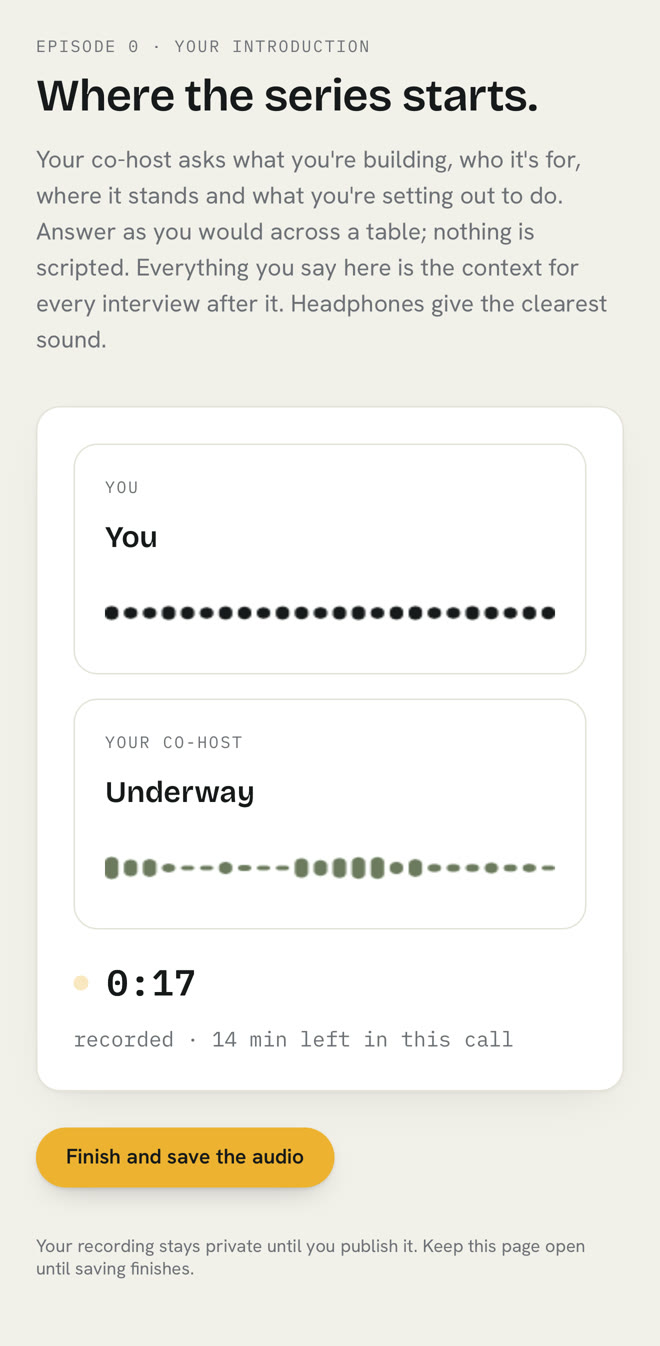
- co-host: a live conversation with an AI co-host that listens, reacts and keeps the thread while you wander. it can look up your own record while you talk, what you shipped on tuesday, when you first mentioned something, and says so when it cannot find it. up to thirty minutes a conversation.
- a person asks: a co-founder or friend asks instead, in the room or by a link. both voices go in.
the questions come from your day. you can connect your calendar, GitHub, your meeting recorder, payments and more, all read-only, or add a note, a voice memo or a screenshot. it proposes threads and you pick. it keeps a private memory of your series that you can read, fix or delete, and other people's voices from meetings never go in an episode.
the episode is numbered and kept in your vault, private until you publish it. it renders as one levelled audio file with the questions in, and as a video with both voices captioned for YouTube and the short-video apps. the raw recording is downloadable on every plan.

prices: three episodes free, no card, and the guided interview works on every plan including those. founder is £29 a month or £290 a year and includes an hour of co-host conversation a month. series is £79 a month or £790 a year, with three hours, the podcast feed for apple podcasts and spotify, and chapters. extra co-host time is £9 an hour.
when underway is not the right fit
- you want a finished show with no speaking: an episode generated from a document. underway records you talking; that is the whole product.
- you want a host for one-off interviews on any subject, not your own work. the questions here come from what you did.
- you want the AI co-host on camera. it is audio only; a video episode is you speaking to the people watching.
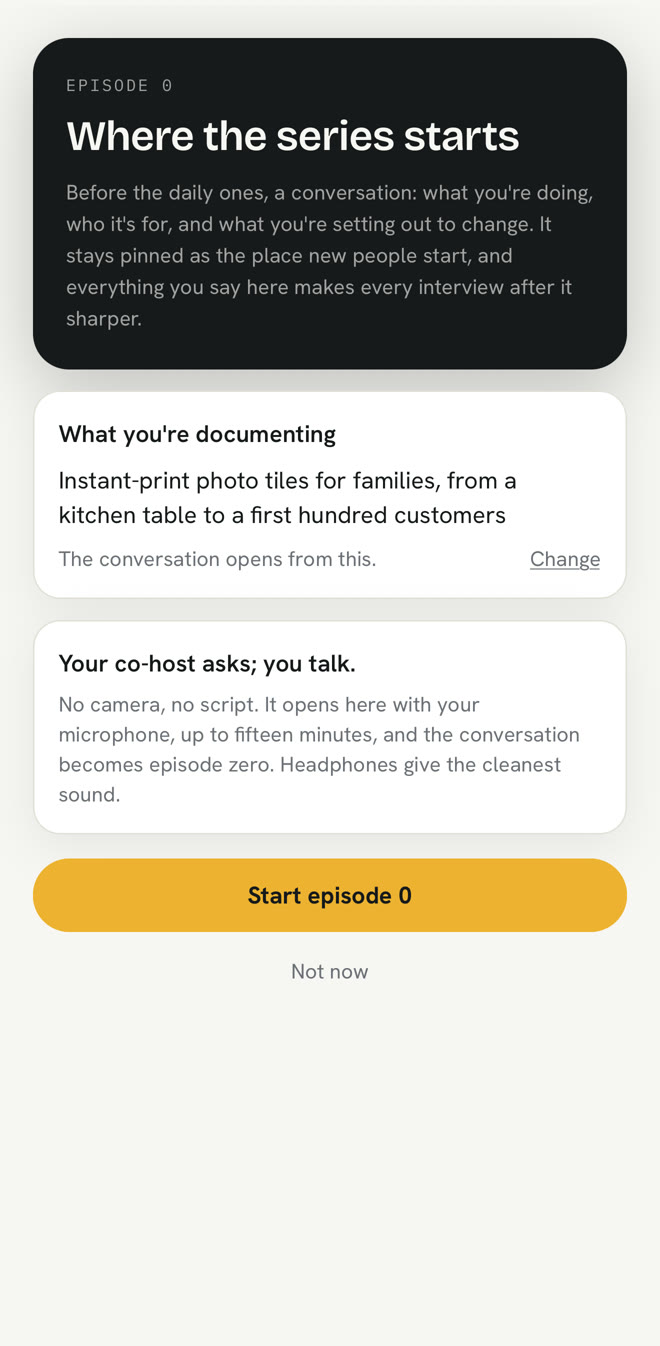
- you want a free live co-host. the co-host is not on the free episodes, apart from an episode zero conversation of up to fifteen minutes. the guided interview is free.
- you want an app from the store. the phone app is built and in testing, not in the app store yet; the web works in a phone's browser.
if you want a regular episode about building your own business, asked by something that knows what you did and remembers what you said last week, that is what it is for.
faqs
is there an AI that will interview me for a podcast?
yes, several. the ones worth using ask out loud, wait for you, and follow up on what you actually said instead of reading the next question off a list. underway does this from your real day, and makes a numbered episode.
does an AI podcast host use my real voice?
it depends on the tool, so ask. in underway your side of the episode is always your own recorded voice. only the host's voice is synthetic, and you choose it.
how long should an AI-hosted podcast episode be?
shorter than you think if you plan to make one regularly. underway's standard interview aims for about three minutes of you talking and stops at five; a live co-host conversation can run up to thirty.
can an AI podcast host ask about what i actually did?
only if it can see it. underway reads connected tools like your calendar, GitHub and meeting recorder, read-only, plus anything you add yourself, and writes the questions from that.
do the questions stay in the episode?
in underway, yes. the podcast is rendered with the host's questions kept in, so it is two voices and sounds like an interview, not a voice note.
where to go next
no tool at all? the manual way to do the same thing: /how-to-interview-yourself-for-a-podcast.
why the interview is live, not a form: /the-interview-is-live-not-a-form.
the episode with no camera in it: /podcast-no-camera.