
Should you change who your startup markets to in the middle of building it?
by Richard Lovatt · updated 22 October 2026
Yes, if your own customers are telling you the positioning is wrong. I built Underway around a loss-driven message, do not miss day one, then found it only lands on someone the moment they start a new project, which is rare. I rebuilt two landing pages mid build: one for business owners on a content-first pitch, one for teams with a book a call funnel, because the pain changed but the product did not.
In short
- A positioning doubt is worth voicing out loud before you rebuild anything, not after
- Loss messaging only converts at the exact moment someone starts a project, which is rare; a content-first pitch catches people all the time
- Selling to one company with many seats can beat chasing many solo founders one at a time
- A book a call funnel suits a product with real onboarding needs more than a self-serve signup button
- Changing the message does not mean changing the product, Underway still reads your day and hands back a finished episode either way
Changing who a startup markets to mid build
I did make a big U-turn, and it started with a phone call that had nothing to do with messaging. I had a call with my Facebook ads guy, my X ads guy wanted to speak to me the next day, and I decided to pause that spend rather than throw more of it at a positioning I was no longer sure of. That is usually how these changes actually happen. Not a strategy session, but a nagging feeling you finally stop ignoring.
The doubt had been building for a day. I had been running ads on a message built entirely around loss: do not miss day one, imagine watching Jeff Bezos build Amazon from the start, nobody filmed it. Everyone I showed it to agreed instantly. The problem was not the message landing, it was that agreeing with a message and being in the exact moment to act on it are two different things, and almost nobody is in that moment when they see an ad.
The problem with loss-based positioning
The pitch worked as an idea and failed as a funnel. People would see the ad, think it was cool, maybe sign up and give an email, but they were not about to start a new project right then. I needed to catch someone at the exact point they were thinking of starting something new, and the odds of that happening in front of any one ad are tiny. You would need to be in front of enormous numbers of people for the maths to work, and that makes the positioning an expensive way to buy customers even when nobody disputes that it is a real problem.
The person who exposed this for me was Ryan, a business owner in California who signed up because the timing happened to be right, he was starting an animation project. But then he asked something telling: whether he could use Underway for his other, more mature business. That question should never have needed asking. If the positioning only speaks to day one, anyone running an established business has to do the mental work of translating the pitch to their own situation, and most people will not bother.
The U-turn: from day one to start now
The fix was a nuanced shift in framing rather than a new product. Instead of capturing someone in the moment they are about to start something, the new line captures someone who already regrets how much they have missed: you regret missing all those days, so start now. That reframes the audience from people at a precise starting line to people carrying an ongoing, constant pain, which is a much bigger and more reachable group.
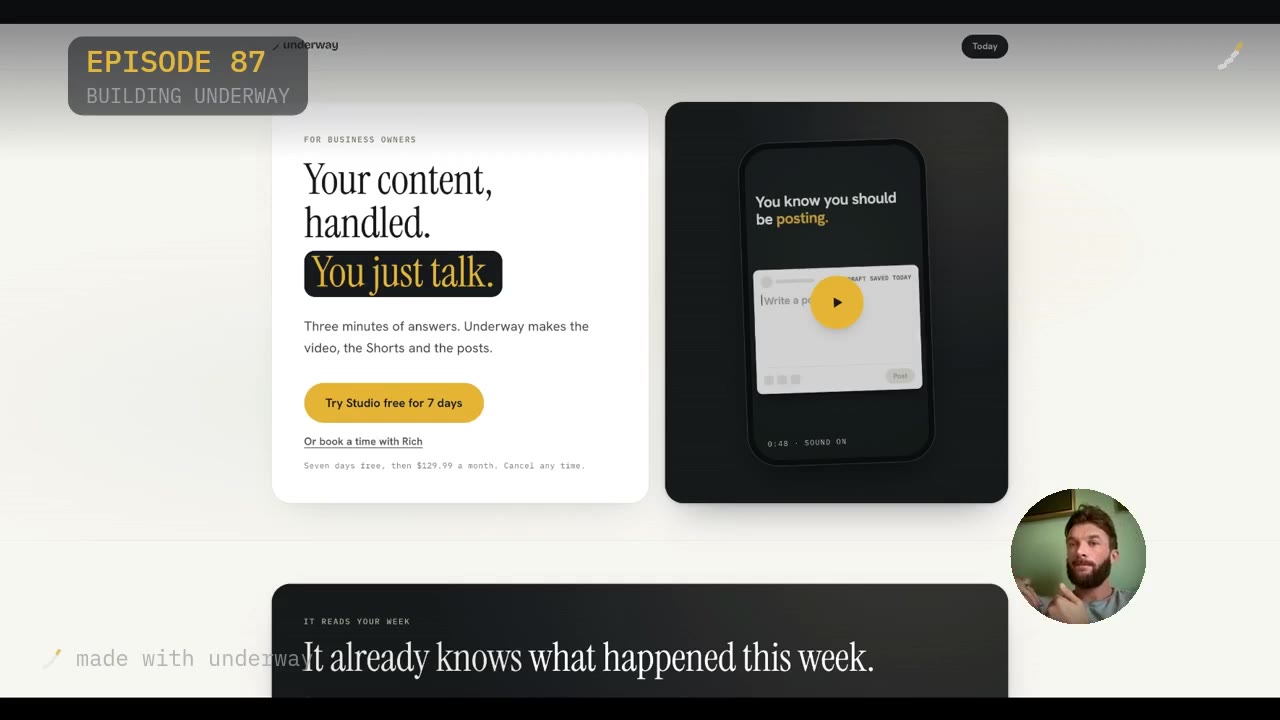
We built two new landing pages off that rethink. One speaks to business owners directly: your content, handled, you just talk. Three minutes of answers, and Underway makes the video, the Shorts and the posts. It opens with Try Studio free for 7 days as the main button, with book a time with Rich underneath as a second option. The other speaks to companies with larger teams.
One company versus a hundred founders
The teams idea came from a conversation with my friend Brandon, who runs an AI agency and had just signed up to Underway himself. He pointed out that once you solve a problem for a business, the problem tends to be large, and so is what you can charge for solving it. That flipped a thought I had been circling for a while: would I rather find a hundred individual founders one at a time, or get into one company that already has twenty, fifty or a hundred employees, and sign them all at once?
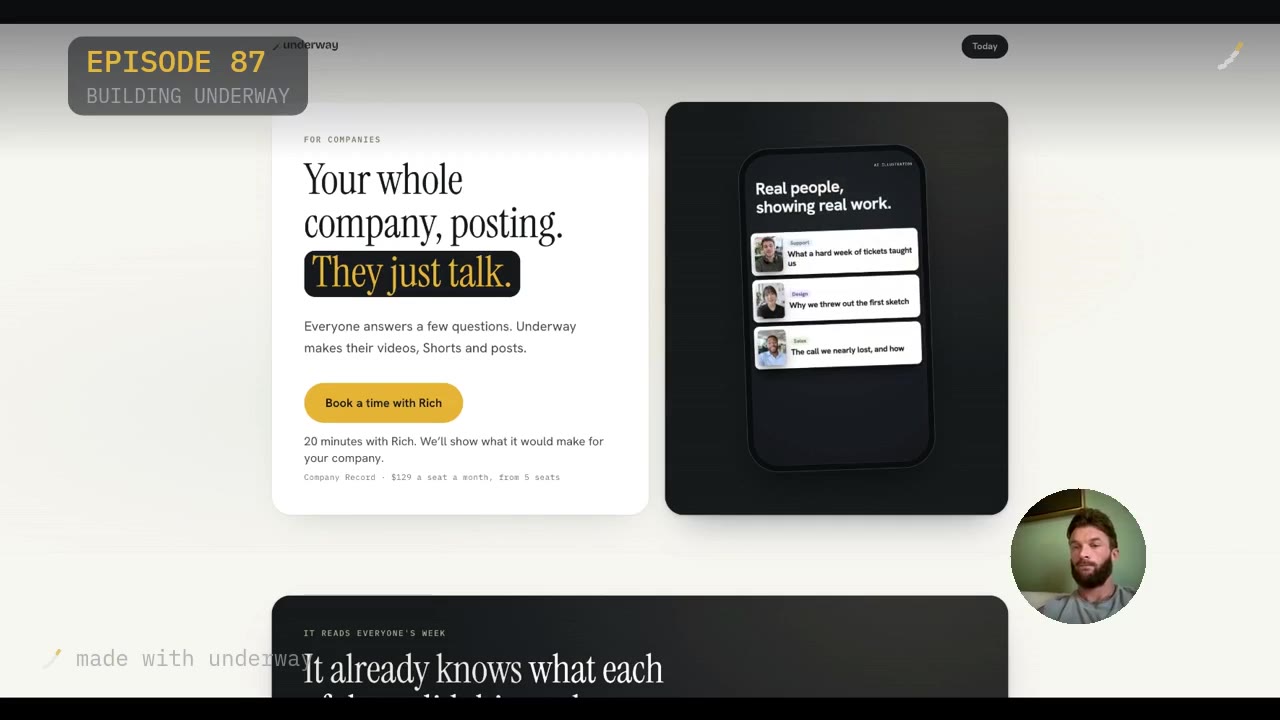
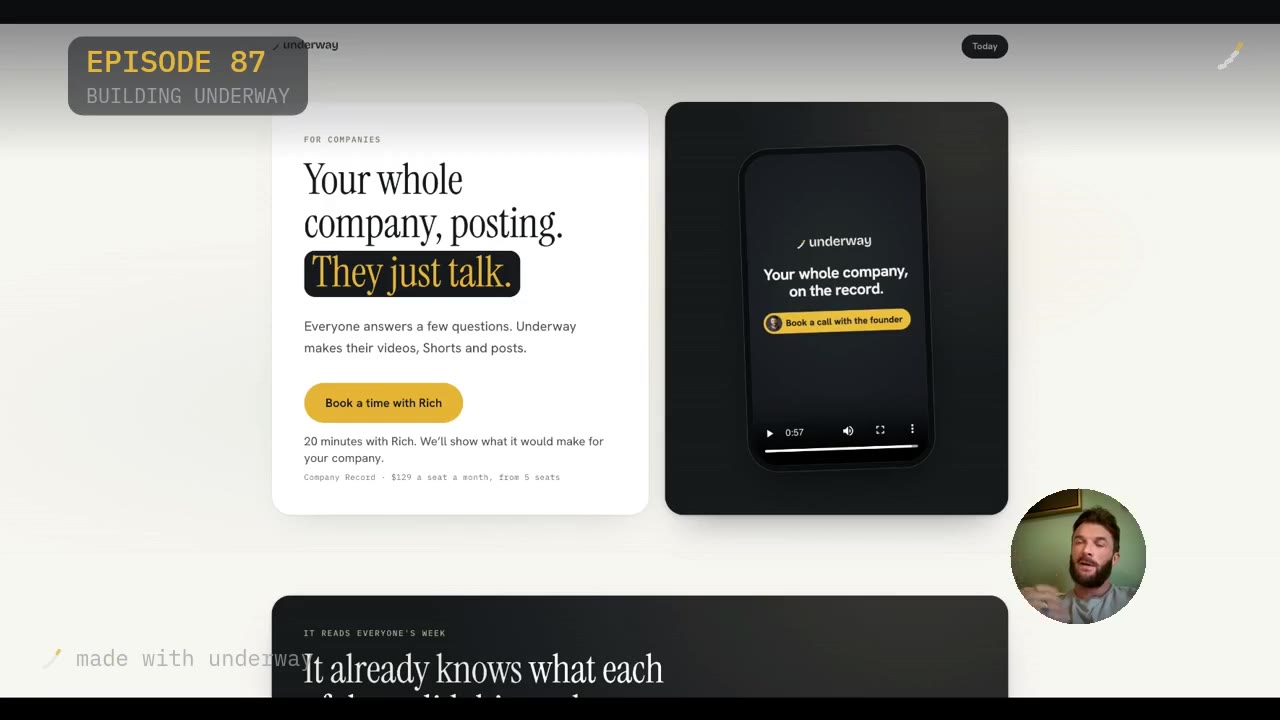
The teams page is called Your whole company, posting, they just talk. Everyone in the company answers a few questions, and Underway makes their videos, Shorts and posts. The page carries real examples of what that could look like: what a hard week of tickets taught support, why design threw out the first sketch, the call sales nearly lost and how. The pricing on this page is Company Record, a seat-based model starting from five seats.
Why I built a book a call funnel for teams
Both new pages exist, but they do not behave the same way. The business-owner page leads with a free trial you can start yourself. The teams page leads with a single big button: book a time with Rich, twenty minutes where I show what it would make for your company. I did that deliberately, because a company with a lot of employees is unlikely to just jump in and pay without someone walking them through it. There are too many things to think about on their side, and a self-serve signup does not give me room to do a proper custom onboarding that accounts for a company's different teams and needs.
It also suits how I actually like to work. I come from sales and marketing, and getting on a call with a founder or business owner lets me hear their wants, needs and objections directly, then speak to Underway in exactly those terms rather than hoping a landing page does that job alone. That is a trade I would make again: for anything with a higher price point or more moving parts, a call converts understanding into a sale better than a page ever will.
What this costs you, and what it does not change
Repositioning mid build is cheap in product terms and expensive in attention terms. I did not rebuild Underway itself, the app still reads your tools and interviews you out loud the same way it always has. What changed was two landing pages, a pricing structure for teams, and where the big button on each page points. That is a matter of days, not months, because the underlying product already does the job; only the story in front of it moved.
What it costs more than time is certainty. I am recording this with the ads paused and the new funnels only just open, so I genuinely do not know yet whether business owners respond better to start now than they did to do not miss day one, or whether one company with many seats will outperform a hundred separate signups. I would rather say that honestly than pretend the U-turn is proven before it has had a single week to run.
Who should change their positioning mid build, and who should not
Change it if your own customers are telling you something your messaging does not say. Ryan asking whether he could use Underway for his other business was the signal, not a metrics dashboard. If people who already like the product still have to ask whether it applies to them, the positioning is doing too little work.
Do not change it on a whim or because ads are losing money on any given day, that happens regardless of message. And do not assume a new audience needs a new product. Business owners and teams get the same Underway that founders get; what changed was which pain I led with and which button I put in front of them, nothing about what the thing actually does.
Questions people ask
How do you know when your startup's positioning is wrong rather than just underperforming ads?
Watch for the same kind of question Ryan asked me: someone who already likes the product still needing to check whether it applies to their situation. If your fans have to do translation work to see themselves in your message, the positioning, not the ad spend, is the problem.
Should a book a call funnel replace a self-serve signup?
Only where the buyer has more to think through than a single page can resolve. I kept the business-owner page self-serve with a free trial, because an individual can decide alone, and used book a call only for the teams page, where onboarding a whole company genuinely needs a conversation.
Is it better to target individual founders or whole companies?
It depends on what you can do with one sale. Landing one company with many employees can outweigh the effort of finding many individual founders one at a time, especially if you can give each company a real custom onboarding, which is exactly the trade I am now testing with the teams page.
Does changing your marketing message mean rebuilding the product?
Not necessarily. Underway did not change when I rewrote the positioning; only the landing pages, the lead message and the funnel did. A loss-based pitch and a content-first pitch are both selling the same reads-your-day, no-editing product, just to a differently framed pain.
What is the risk of pausing paid ads to rework positioning?
You lose the data you would have gathered by letting the old campaign keep running, and you delay any signups that message might still have produced. I judged it worth pausing the X ads call specifically because I did not want to spend further on a message I already doubted.