
Article
building a startup while working full time, on camera
4 October 2026 · 9 min read
Post on Xthe film above is a dramatisation. daniel is not a real person, and the bank, the churned customer and the resignation are made up to show how the product works. the vault, the numbering, the release in order and the filming dates are how underway actually behaves.
the message on his phone at the start is real too, word for word. connect whatsapp or slack and underway tells you when something lands, a payment, an email, a meeting that ended, and asks if it is worth filming, with three buttons: film it, tell me more, not today. it never asks in the middle of work, and saying not today costs nothing.
the short answer
building a startup while working full time comes down to three things: a small, fixed amount of time you can keep, a clear line between the job and the company, and a record of what happened while nobody was watching. most advice covers the first two. almost none covers the third, and it is the one you cannot fix later.
keep the hours modest and regular rather than heroic. keep the company off your employer's time and equipment, and read your contract. and document it privately as you go: a short entry whenever suits you, numbered, dated, kept. on the day you go public, or quit, the months before are already on film, in order, in your own voice.
what the usual advice on building a startup while working full time gets right
read page one for this phrase and you get the same sound advice in a dozen shapes. it is worth repeating because it is true.
- protect a small block of time and keep it. an hour before work most days does more than a heroic weekend once a month.
- work on what moves the company: talking to the people it is for, and getting something in front of them. the logo can wait.
- use the salary. it is the funding that lets you test an idea without a deadline you did not choose.
- validate before you leap. a real customer or a real waiting list is a better reason to quit than a good feeling.
- keep the two worlds apart. your own laptop, your own phone, your own hours.
on the employment side, one plain line: check your contract and any policy on outside work or intellectual property, and if anything in it is unclear, ask a lawyer where you live. this page is not legal advice and does not try to be.
what the guides skip is what happens to the story. the side-project years are when the interesting things happen: the first customer, the first one who leaves, the day you tell your manager. they are also the years least likely to be recorded, because you are tired, you are quiet about it, and there is nobody to post to.
why the side-project months are the story
when a founder finally goes full time, the announcement usually summarises the months before in a paragraph. it is written from memory, with the ending known, by someone who now remembers the build as more certain than it felt.
footage filmed at the time does something a recap cannot. it shows you not knowing. the week a customer churned is told by someone who did not yet know whether the company would survive it. the day you resigned is told on the day, not tidied up six months later. that uncertainty is what makes people care, and it only exists if you recorded it then.
you can write the website the week you launch. you can hire someone to make a product video. you cannot go back and film the beginning.

how to document building a startup while working full time, without anyone knowing
the obstacle to documenting a side project is not willingness. it is overhead and secrecy. you do not have an hour a day to film and edit, and you cannot post any of it yet. so the method has to be short, and it has to be private by default.
that is how underway works. once a day, whenever suits you, it interviews you on camera about what you actually did: a few spoken questions, aimed at about three minutes of answers and stopping at five. it cuts the answers into a numbered episode, in the order you said them, with nothing reordered and no words added. on a day you do not want to be seen, the same interview can be a podcast, voice only.
every series starts in stealth. nothing leaves the app until you say so, and nothing in the vault is ever published on its own. the episodes are cut, numbered and kept, and nobody sees them.
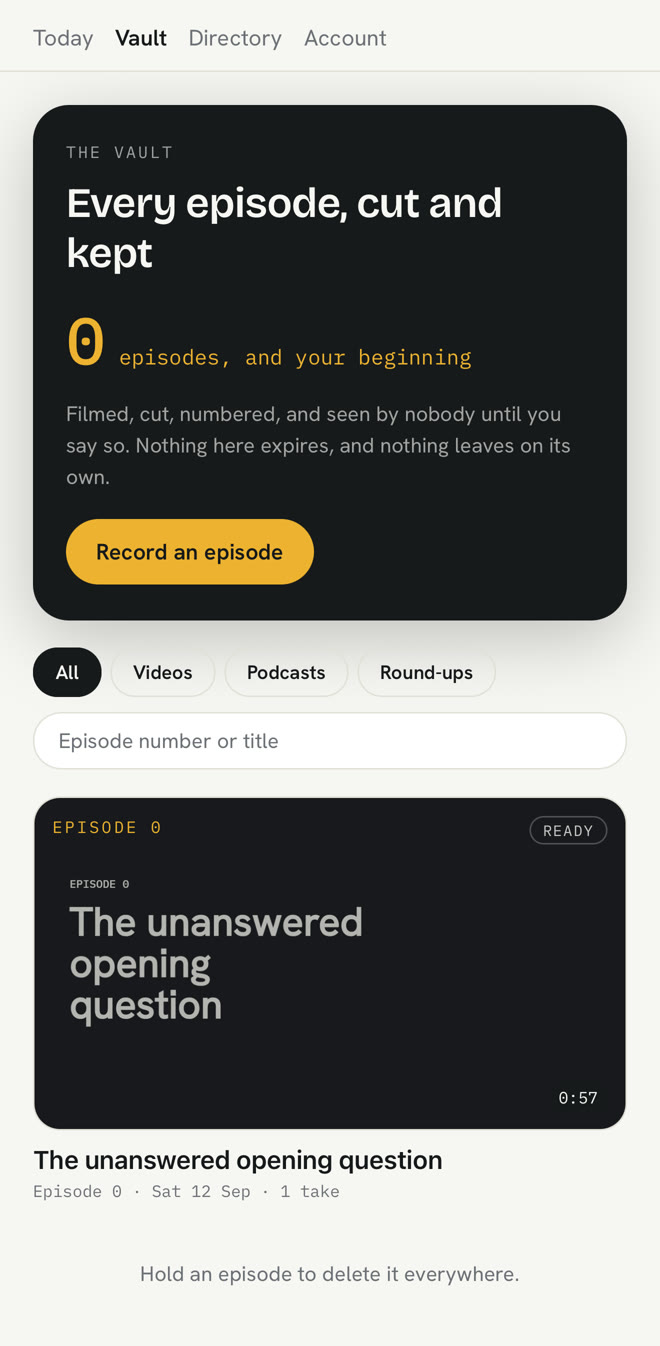
it starts with episode zero, an introductory conversation: what you are building, who it is for, what they do instead today, where it honestly stands, the hardest part, and what you are setting out to do. filmed while you still have the job, it is the most honest version of that answer you will ever give. later it becomes the start-here episode.
a rhythm that fits around a job
a day job means some weeks there is nothing to film and some weeks there is no time. a habit that demands every day will break in the first busy fortnight. a few things in underway exist for exactly that:
- the reminder arrives at a time you pick, every day. before work, at lunch, on the train home: whichever you can keep.
- your commitment is yours. weekdays by default, or three a week, or every day. the streak counts against what you chose, not the calendar, so three episodes on a three-a-week commitment is an unbroken run.
- a pause is one press. a work trip, a launch at the day job, a holiday: pause the streak, no reason asked, and start again when you are back.
- episodes are counted, not days. episode 41 follows episode 40 whenever it is filmed, with its date on it. a gap is just a gap.
- lowering the commitment after a hard month is a normal settings change. the app never suggests raising it.
what to say on a day you only had forty minutes for the company? that is often the best episode. the one thing you got done, the thing that is stuck, and how it felt doing this after a full day's work. the interview asks about the day you had, so you do not have to prepare anything.
showing it to one person without going public
while the build is private there are people you may want to show: a co-founder you are courting, an adviser, an investor, a partner who keeps asking what you do with the spare hours. publishing is the wrong tool for that.
share the vault privately, at the top of publishing on the web and the phone, makes a watch-only link to every finished episode. it can be open to anyone with the link, or to only these people, each with a link that opens for nobody else. add a password if you want one and set how long it lasts. nothing is listed anywhere, nothing is downloadable, and switch it off ends it in one press.
the day you go public
when you are ready, whether that is the day you resign or a year after, going public is an explicit action. everything filmed before it becomes season 0, and the public series starts at season 1, episode 1. a new viewer is never in doubt about which episode is the current one.
release the vault then puts every finished episode on your page in one go, oldest first, each carrying the date it was actually filmed, with episode zero as start here. any single episode can be held back for good from its own page first: some side-project days should stay private, and that is your call per episode. the details of the launch itself, what to announce and where, are in the guide to coming out of stealth linked below.
| the months before you go full time | not recorded | filmed in private with underway | |
|---|---|---|---|
| how the story gets told | a paragraph written from memory | episodes filmed on the day | |
| who sees it while you still have the job | nobody, because it does not exist | nobody, unless you share a private link | |
| the dates | roughly remembered | the day each episode was filmed | |
| the bad weeks | smoothed over | told by someone who did not know how it ended | |
| on the day you go public | one announcement | season 0 released in order, season 1 starts |

what it costs
three episodes are free, with no card. stealth costs nothing extra on any plan, free included: every series is private until you choose to publish. releasing the whole vault in one go, oldest first with episode zero as start here, comes with any paid plan: founder at $29 a month or $290 a year, or series at $79 a month or $790 a year, which adds the podcast feed and one tap to every connected network. raw footage is downloadable on every plan.
is it possible to build a startup while working full time?
yes, and plenty of founders do, usually with a small block of time they can keep every week rather than long bursts. the hard part is less the hours than keeping going through the busy weeks. a commitment you choose, and a pause for the weeks you cannot, does more than willpower.
can i document my side project without my employer finding out?
in underway, yes: every series starts in stealth, nothing leaves the app until you say so, and nothing in the vault is published on its own. that is about the app, not your contract. check your employment contract and any policy on outside work yourself, and ask a lawyer if anything is unclear.
how much time does a daily startup diary take?
underway's interview aims for about three minutes of answers and stops at five, and the cut is made for you. you can film whenever suits you, and on a day you would rather not be on camera the same interview can be a podcast, voice only.
what happens to the episodes when i quit my job and go public?
everything filmed before you go public becomes season 0. on any paid plan, release the vault puts every finished episode on your page in one go, oldest first, each dated the day it was filmed, with episode zero as start here. your public series then starts at season 1, episode 1.
can i keep some episodes private forever?
yes. any episode can be held back for good from its own page, whatever the rest of the vault does, and put back in the release with one press if you change your mind.
where to go next
the launch itself: what to announce, where, and how the stealth months go out. coming out of stealth mode.
a diary nobody sees until you choose, and what private means in practice. a private video diary app.
what to record, and how often, once you start documenting. how to document your startup journey.