

the short version
everyone says document the journey. almost nobody says how, and the people who try mostly stop in week three. here is a method that survives contact with a tired tuesday. it is the one underway is built around, and most of it works without any tool at all.
one. start with an episode zero
before the first daily entry, record the setup, as a conversation rather than a piece to camera: what you are building, who it is for, what those people do instead today, where it honestly stands, the hardest part, and what you are setting out to do by when. do not sell it. a question that invites marketing language has failed. in underway it is a conversation with a co-host, on camera or with just your voice, asking and following what you say: a three-minute practice first if you want one, then up to ten minutes. episode zero is the entry point for anyone who arrives at episode 47, and it is the context every later question is asked against. a founder ten years in has more to say here, not less.
two. write one line about what you are documenting
not a category, your own words. "taking the agency from ten clients to a hundred." "opening the second shop." "learning to sell." everything else is generated from that line, and it is the thing that keeps the questions about your business rather than about businesses in general.
three. a daily cue, at a time you choose
not weekly. a weekly update is an appointment and appointments get cancelled. the cue has to arrive at the same hour every day, whatever hour suits you, even on the days the entry is thirty seconds. the commitment can be weekdays, or three a week; the cue is daily regardless.
four. answer questions, do not present
an interview about the day you had gets the real story out; a piece to camera gets a performance. the beats are the same most days: how it started, what you worked on, what broke, what you did, what changes. about three minutes of answers, then stop, while you still have something left to say.
five. keep it in order
the honest structure is chronological. the day it went wrong comes before the day it got fixed, and nobody moves the good line to the front. a reordered video feels produced; a chronological one feels like a diary, and the diary is what people come back for.
six. count episodes, not days
the number goes on the front of every entry and only rises when you press the button. a gap is invisible; a numbered day you skipped is a public failure. track the streak separately and privately, against the days you actually committed to, and give yourself a declared pause for holidays rather than a broken chain.
seven. decide the look once
one title card, one accent colour, one typeface, the same every episode. someone who sees episode 12 and episode 40 should recognise them instantly. that recognition compounds exactly the way the episode counter does, and it is the whole brand. do not redesign it monthly.
eight. keep the archive, not just the posts
every entry, dated, transcribed, downloadable, in order. the posts are a by-product. the archive is what a new hire watches in their first week, what you send an investor instead of a deck, and what a documentary would be made from if that day ever comes.
nine. publish when it is worth it, not before
private from day one is fine. release the archive whole on launch day, in order, to the places built for a back catalogue: a public page, a podcast feed, a youtube playlist. the feed gets one launch post, not forty, because a feed cannot hold two timelines at once.
ten. protect the bad day
an audio entry from the car, one question answered in thirty seconds, a few words over the moment you caught at lunch. the day you nearly skipped is the day the habit is decided, and the entry only has to exist.
how to document your business journey on social media
most people asking how to document your business journey on social media are really asking two things: which platform, and how often. the honest answer to the first is that you do not choose one. you make one recording and let each platform carry the piece it is built for. the answer to the second is steps three and six above: record on the days you committed to, post what is worth posting.
- tiktok, instagram reels, youtube shorts and snap: the portrait episode itself. one nine-by-sixteen file serves all four, with a caption and hashtags for the short-form apps and a line or two for snap.
- youtube: the longer landscape episodes, the weekly recap and the month in one film, added to your series' playlist so the whole run plays in order from one link. a portrait episode of three minutes or under goes up as a short.
- linkedin: the sixteen-by-nine file where you have one, and a first-person post with no thread structure. people there read before they watch.
- x: a thread of three to five posts, with the episode's video on the first.
- reddit: a post with its own title, no links and nothing that reads like a pitch, in a build-in-public community, with the episode added on reddit's video tab.
- podcast apps: the audio of every episode, questions kept in, through one feed. submit it once and a back catalogue arrives whole, in order.
- your newsletter or blog: a longer article written from the same transcript.
one recording, different words per platform
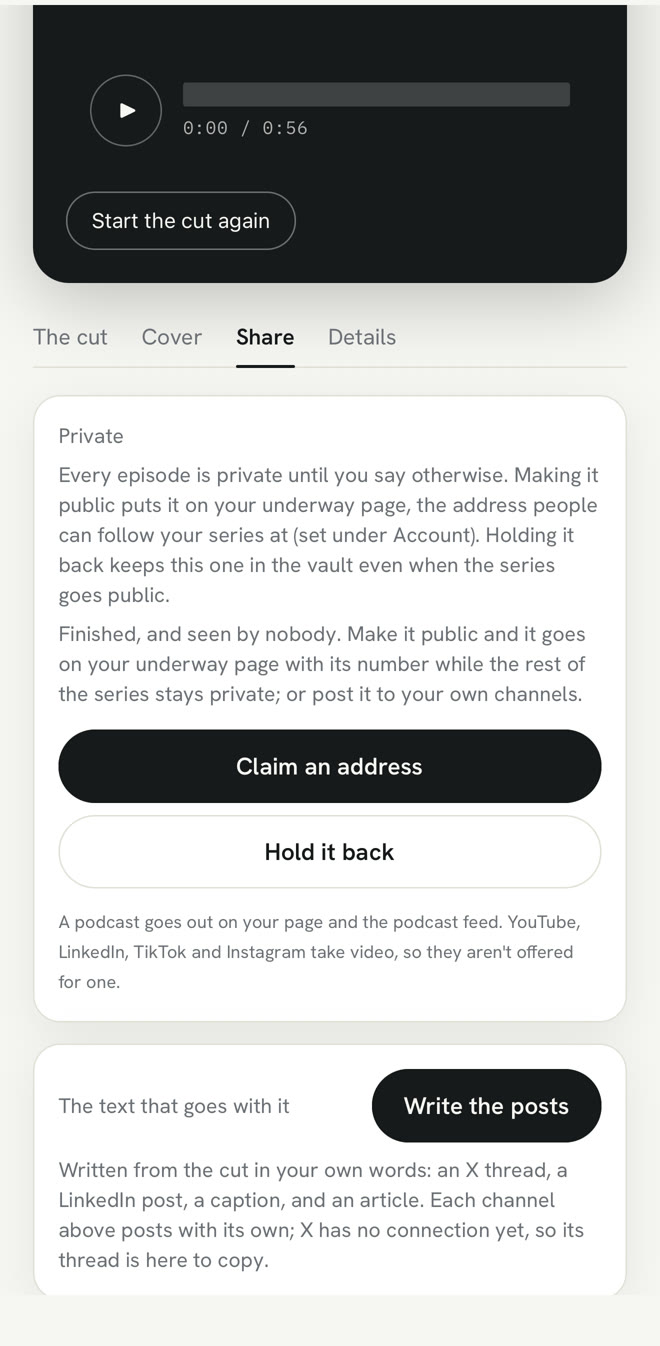
the recording does not change per platform. the words around it do. in underway the posts are written from your transcript once every answer is transcribed, one per place, and every one follows the same outline: a line that places the episode, a reason a stranger should care, what happened in plain terms with one line of yours from the transcript, a short list of what else it covers, and who it is for. the platform changes the length and the form, never the depth. the caption is the same story at phone length, not a sentence and some tags.
you read every one before it goes, and change any word in the box. it is your name on it. on series the episode page posts to the channels you connect, each with its own words, and post everywhere sends it to every channel you ticked; x always shows you the thread first. on founder the same words sit on the episode page and you post them to your own accounts. nothing is ever posted on its own.
why the archive matters more than the feed
posts decay. a social feed is ranked mostly by recency, so what you posted in march is effectively gone by may. if the only copy of your business journey is the posts, the journey goes with them. the archive is different: the numbered run in your vault, every episode with its filming date and transcript, downloadable in full on every plan, and a public page that holds the run in order with episode zero at the top under start here.
social media is where people find you. the archive is where they catch up. link every post back to the episode's own page, and the stranger who liked one clip can watch the story from the beginning rather than guessing at it from the middle.
if you want to keep it on video, a founder video diary: a founder video diary.
which social media platform is best for documenting a business journey?
the one where your people already are, with the others carrying the same episode. one portrait file goes to tiktok, reels, shorts and snap; linkedin and youtube take the longer landscape cut.
do i need a different video for each platform?
no. what changes per platform is the text around the video, written for each place from the same transcript.
how often should i post?
record on the days you committed to and post what is worth it. private from day one is fine, and the archive can be released whole later, in order.
what if i miss a day?
episodes are counted, not days, so a gap is invisible to the audience. the streak counts against the days you chose, and a pause protects it.
is it free to start?
the first 14 days are free, with a card and nothing charged until day 15.
underway does the asking, the cutting and the counting, and keeps the archive. start today, whatever stage you are at. the first 14 days are free, with a card and nothing charged until day 15.
this is part of underway's guide to founder-led content: founder-led content, without the work of creating it.