
Article
build in public burnout: why it happens, how to stop it
30 September 2026 · 9 min read
Post on Xthe short version
build in public burnout rarely comes from sharing. it comes from inventing. every update means deciding what to say, setting up, recording or writing it, editing it and posting it, on top of the work it describes. that is a second job, unpaid, done when your energy is lowest. people quit second jobs.
the way through is to cut the overhead, not the honesty. answer questions about the day you actually had instead of inventing content. count a streak against a commitment you chose, with a pause for the weeks that go wrong. keep a very short episode for the bad days. and if the problem is being watched rather than the work, keep recording in private and decide about publishing later.
the rest of this page is the diagnosis, each fix in turn, and an honest section on when stopping is the right call.
what build in public burnout actually is
most of what ranks for this treats it as social media burnout: screen time, notifications, comparison, the doom-scroll. those are real, and the general guides cover them well. but a founder who burns out on building in public usually is not scrolling. they are sitting in front of an empty post box after eight hours of building, trying to make today sound like progress.
the essays titled "building in public is dead" or "overrated" tend to blame the idea itself. read them closely and the complaint is nearly always about the workload, or the feeling of performing, or posting into silence. very few of them say honesty was the problem. almost all of them say the effort stopped feeling worth it.
the signs are specific, and you probably recognise some:
- the update takes longer than the thing it describes.
- you only post on good days, so the feed stops being true, and you know it.
- you dread the post more than the work.
- a missed week feels like a public failure, so you miss another one to avoid explaining the first.
- your updates have started to sound like marketing copy, and you can hear it.
- you think about the metrics of the last post while writing the next.
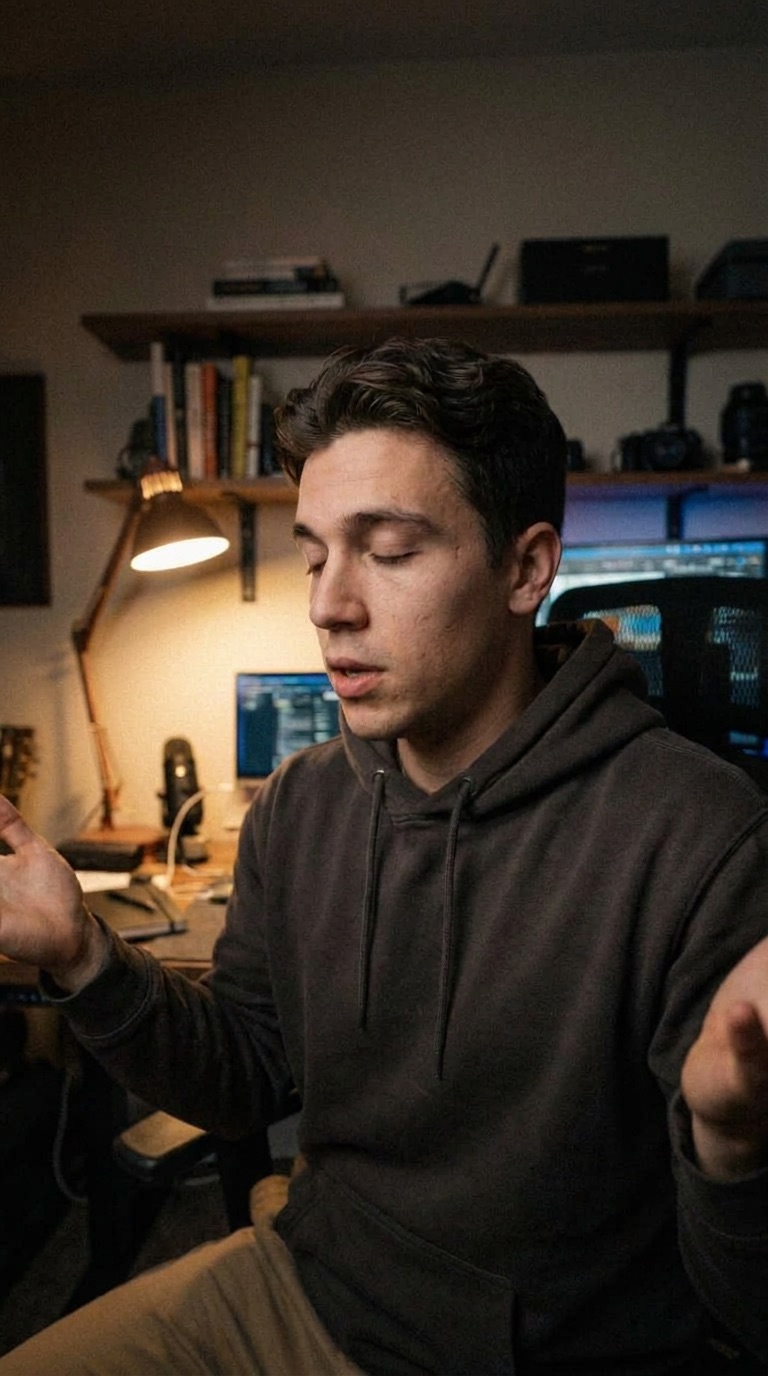
what causes build in public burnout: the overhead, not the sharing
count the jobs in a single video update. decide what to say. set up: light, angle, background. record it, usually more than once. edit it. then write the words that go around it, differently for each place it goes. that is five jobs, and the first is the heaviest by a distance.
deciding what to say is creative work, and you are asking for it at the point in the day when your creative energy has already gone into the product. a blank camera and a blank post box ask nothing. you have to supply the question and the answer, every single day.
it compounds, too. content invented from nothing tends to sound invented. it lands flatter, so next time you try harder, which costs more, which makes the next one more likely to be skipped. that loop, not the act of being public, is what grinds people down.
| inventing content | answering about today | |
|---|---|---|
| deciding what to say | you, from nothing, every time | questions written from what happened: your calendar, commits, notes |
| setting up | lights, angle, a script | the laptop or phone where it was yesterday |
| recording | often three takes to get it clean | one pass; false starts and filler are cut out |
| editing | an hour in an editor | none; the cut, captions and card are made for you |
| words for each platform | written by hand, one per place | drafted from what you said; you read them and send |
| a bad day | nothing to post, so nothing posted | a thirty-second episode, or voice only |
answer questions about today instead of inventing content
an interview reverses the load. you stop being the writer and become the source. the question arrives from outside, about something that really happened, and you answer it the way you would answer a friend who asked how it went. nobody burns out answering a friend.
that is how underway works. it reads what you connect, read-only (your calendar, GitHub, your meeting recorder and more), plus anything you add yourself, a voice note or a screenshot. it suggests a few threads from what the day turned up and you pick one or write your own. then it asks out loud, one question at a time, and follows up only when you named something specific and left it unexplained.
it also has a clock. a standard episode aims for about three minutes of answers and stops at five, enforced in code rather than left to judgement. it stops while you still have something to say, on purpose: an interview that drains you today is one you skip tomorrow.
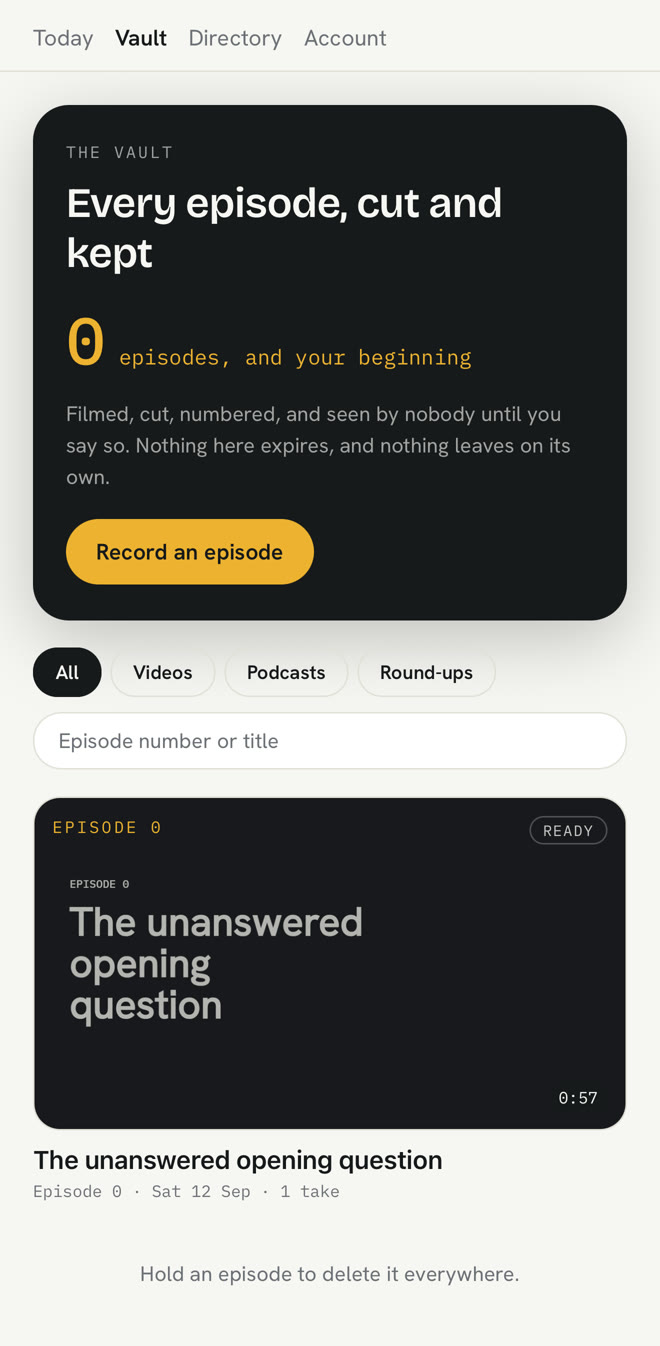
then the edit disappears. your answers are cut together in the order you said them, filler and false starts removed, a card with your episode number on the front and captions burned in. the words for X, LinkedIn, the short-form caption and the rest are drafted from your own transcript. you read them before anything goes out, and nothing posts on its own.
you do not need an app to use the principle. a friend asking you three questions over a call, with your phone propped on a stack of books, gets you most of the way. what matters is that the question comes from someone else and is about something real.
build in public consistency: a streak you chose, with a pause
streaks burn people out when the target belongs to someone else. daily, because a thread said daily. a countdown to day 100, which is a countdown to failing. the fix is not to drop the streak. a record of showing up is motivating. the fix is to make it yours.
- the commitment is yours: weekdays by default, or every day, five a week, or three a week. filming monday, wednesday and friday on three a week is an unbroken streak.
- pausing is one press. no reason asked and no limit on how often. start again is the same button when you are back.
- lowering the commitment after a hard month is an ordinary settings change. the app never proposes raising it.
- episodes are counted, not days. after a missed week the next episode is simply the next number, so there is no visible gap to explain.
- dismissing the daily prompt costs nothing: no streak damage, no second ask, no guilt copy.
- there is never a target. it acknowledges what has accumulated and never counts down to anything.
the reminder arrives at a time you pick, every day, even on a three-a-week commitment. that sounds backwards but it is the point: a cue that moves is not a habit, and a cue you can ignore for free is not a burden.
keep a very short episode for the bad day
streaks rarely die on a busy day. they die on the flat day after a bad one, when there is nothing you want to say and no energy to say it. the fix is a version so small it is hard to refuse.
in underway, Not now on the setup screen gives you the rescue: one question, thirty seconds, and it counts. the Short length is about a minute. or skip the camera and make it a podcast: voice only, questions kept in, recordable from a car or a walk. a bad day is often the episode people remember, because it is the one that sounds true. but you do not owe anyone the bad day, and a thirty-second one is enough.

how to keep building in public after you have already stopped
if you are reading this after a gap, the gap is not the problem. the problem is the story you have built about the gap, and the post you think you owe explaining it. you do not owe it. one line at most, then carry on.
- pick the lightest commitment you could keep on your worst week, not your best. you can raise it yourself later.
- set the reminder for when you really have ten minutes, not the slot you wish you had.
- make the first one back about one small thing from today. not a comeback, not a recap of the missing weeks.
- decide separately whether to post it. recording and posting are two choices, and making them one is how a single bad day turns into a month off.
- set the look once and leave it. redesigning the card is a way of not filming.
when to stop building in public, or go private
sometimes the honest answer is less public, not more. building in public is a tool, not a virtue, and there are good reasons to put it down:
- the business needs quiet: a stealth product, a pivot you have not announced, a job you have not left.
- the public part is the part that hurts: comments, comparison, a competitor reading along.
- you are posting for an audience that is not the one you need, and the effort is coming out of the work.
- you are in a stretch of life where the product has to wait, and the updates are the last thing holding you to it out of guilt.
for the first three, going private keeps what matters. in underway every episode stays in the vault until you send it, and a whole series can run in stealth: same interview, same numbers, nothing leaving the app. if you go public later, the vault can be released in one go, oldest first, each episode carrying the date it was filmed, and any episode can be held back for good. that footage of the early days is the one thing that cannot be made afterwards, so it is worth keeping even if you never show it.
and if you want to stop entirely, stop. raw footage is downloadable on every plan, free included, and deleting your account removes everything. a streak product that makes stopping hard is one to be wary of.
faqs
is build in public burnout different from social media burnout?
partly. social media burnout is about consumption: scrolling, comparison, notifications. build in public burnout is mostly about production: deciding what to say, setting up, recording and editing, every day, on top of the work. the fixes are different. the second one is solved by cutting the overhead of making each update.
how do i keep building in public consistently?
choose a commitment you could keep on a bad week, pause it when you are away instead of breaking it, make each update cost a few minutes rather than an hour, and have a thirty-second version for flat days. consistency comes from low cost per episode, not from willpower.
how often should i post when building in public?
as often as you can sustain for a year, not a fortnight. weekdays is a sensible default, three a week is fine, and recording can be more frequent than posting. what builds an audience for a serial is regularity, not volume.
should i post about bad days?
if you are comfortable to. the bad day is often the most watched, because it is the one that sounds true. but a short, honest episode that says it was a flat day is enough, and you can always record and keep it private.
what happens to my streak if i miss a week?
in underway, if you paused first, nothing. if you did not, the streak restarts, but the episode number does not: the next episode is just the next number, with no gap and nothing to explain.
what does underway cost?
three episodes are free, no card. Founder is £29 a month or £290 a year. Series is £79 a month or £790 a year.
where to go next
coming back after a gap, without the apology post: /get-back-to-posting-after-a-break.
how often is often enough: /how-often-to-post-when-building-in-public.
what to say on a day when nothing happened: /what-to-post-when-nothing-happened.