
Directory · Risk Takers · S1 · Episode 1

S1 · Episode 1

Opus Clip and Riverside alternative: why I built my own

filmed 2 November 2026 · 12:16

♡ Like
XLinkedInWhatsApp

I explained what Underway is, the product I'm building with Rich that turns podcast conversations into highly produced videos and clips with data cards, charts and definitions, built as an alternative to Opus Clip and Riverside. I used Opus Clip for clips but found them generic, with no proper start, middle or end, and I'd been using Riverside for full episodes until I built my own engine instead. Underway now handles guest outreach, booking, recording in HD or 4K, editing, cutting horizontal and vertical clips and posting them, all front to back for other podcasters. I'm planning to post updates on Underway most days going forward.

What is a good Opus Clip and Riverside alternative, and why would you build your own?

by Alessandro · updated 2 November 2026

I built Underway with Rich after Riverside and Opus Clip stopped being good enough for Risk Takers. Riverside records separate tracks well but just stitches them into a plain video. Opus Clip's clips had no real start or end. Underway is the tool I built instead: it understands what is being said and adds data cards, charts and definitions on screen, then cuts that into clips.

Key numbers

I don't care if the clip's 15 seconds or 15 minutes, to be honest I actually don't care, what I care about is that the clip has a start and an end.

In short

  • Riverside records clean separate tracks but does nothing to make the finished video understand the conversation.
  • Opus Clip's automatic clips jumped around with no proper start, middle or end, so I stopped using it.
  • Underway is the engine I built with Rich: it reads the conversation and brings up the right chart or data card for what is actually being said.
  • I don't care if a clip runs 15 seconds or 15 minutes, only that it has a start, a middle and an end that makes the point.

What Risk Takers Is

Risk Takers is a podcast I'm building where I get people who are genuinely good in their niche on for real conversations. Along the way I built an engine that takes that raw conversation and turns it into something properly produced: pop-ups on screen, data cards, definitions, the works, front to back.

I'd tell anyone curious about the finished product to go and look at the comments on the channel rather than take my word for it. What I talk about on the show is relatively complex. A lot of the terminology is hard to get your head around the first time you hear it, even though people study this stuff at university for years before they start talking about it casually.
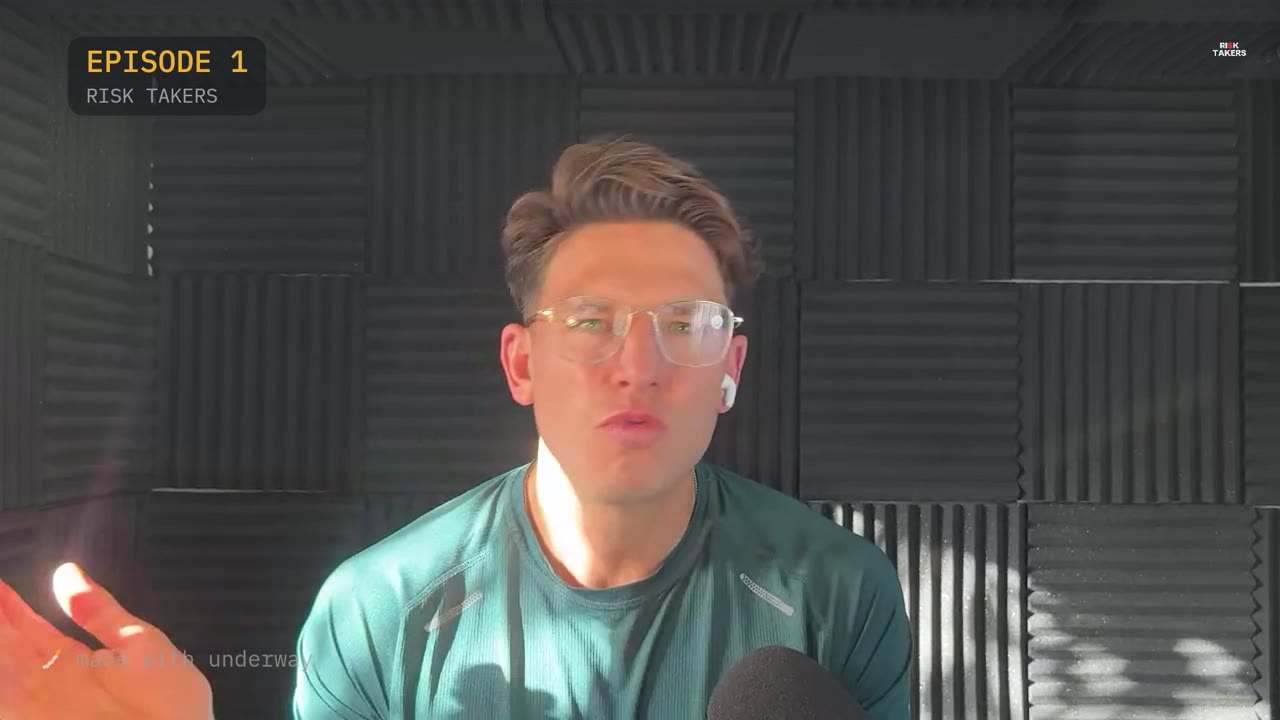
Episode 1 of Risk Takers, filmed in the founder's sound-treated recording room.

Explaining Complex Terms Without Killing the Conversation

I felt this myself, coming at markets from a slightly different angle. Someone would say the yield curve, or the base rate, or a basis point, and I'd have to hear the term a few times before I had even a conceptual idea of what it meant, then go away and research it properly.

What I want my show to do is help explain what's going on inside the content itself, without ever interrupting the conversation to ask a guest to define something. That kills the conversation and it's irrelevant anyway. I don't want to get an expert on and then make them explain a basic concept. Basic concepts can be Googled, or you can just ask Chat. The problem is you don't know what question to go and ask until you've heard an interesting conversation first.

That's what Risk Takers started as, and it's what's let me produce episodes where people can actually understand what's being said, because we use visual representation and description alongside the talking to help them follow it.

Why Opus Clip and Riverside Weren't Good Enough

I used to use Riverside for recording the show, and I used Opus for clips, until I started building Underway instead. Riverside captures audio and video cleanly, each person on their own camera, stitched together properly, and honestly I think a remote conversation often looks better on YouTube than an in-person one, because in person it's hard to get a camera straight on someone's face. But Riverside just takes those two tracks and turns them into a video. It makes a nice video. Nothing about it makes the video exceptional.

Opus was worse. The clips it produced were horrendous: no proper start, no middle, no end, they didn't make the point, they just jumped around. The engine making them was so generic it did nothing to make any individual clip good. So I decided to try building a clipping tool of my own instead that clips my own show and does it properly.

Why I Built My Own Tool

I spent a long time getting irritated, and spending a lot of tokens, making sure Claude understood what actually makes a start to a clip. I don't care about a flashy hook, it just needs to open on a normal bit of conversation. For the middle, does the person round out their point. I don't care whether the final clip is 15 seconds or 15 minutes. What I care about is that it has a start and an end and makes the point, because clips that don't make me annoyed.

Beyond the cut, the engine has to understand what's actually being discussed. If a guest is talking about mortgage rates, the right chart isn't the Fed funds rate, it's the US 10 year, because that's what mortgage rates are actually anchored to. That takes real understanding of the subject, not a generic template, before the chart and the explanation can bring the guest's point to life on screen.
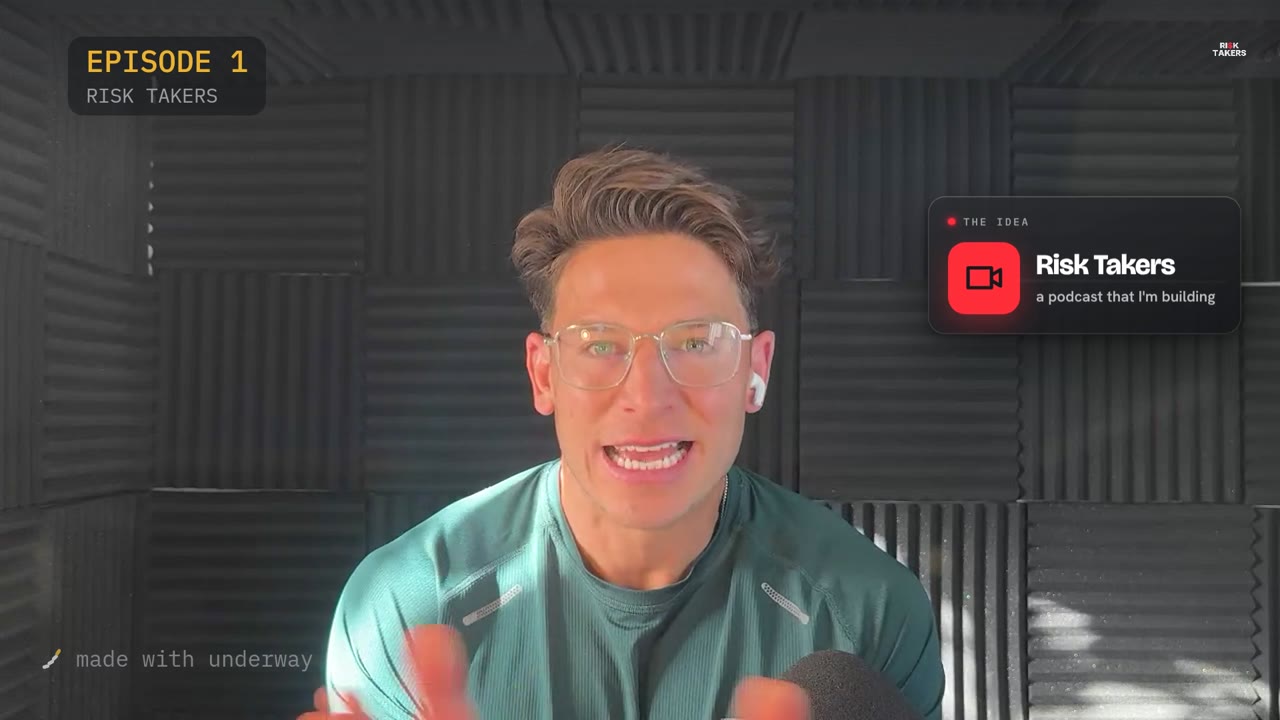
On-screen label naming Risk Takers as the podcast the founder is building, the idea that led to Underway.

How Underway Is Meant to Work, Step by Step

Underway is software, not a service I run for people. The plan, as I've laid it out, is that a creator signs up and gets access to the engine covering the entire production front to back: Underway handling outreach by email to find good guests in a creator's niche, booking them into the calendar, recording each person's own track in HD or 4K on their own mic, then combining those tracks into a finished video.

From there the engine decides the shape of each moment, sometimes the host full screen, sometimes the guest, sometimes split screen, sometimes bringing up an article, a data card or a chart relevant to what's being said, with descriptions and headlines at the bottom. It then cuts that into horizontal and vertical short clips and can connect to YouTube and X to post with captions.

What a creator still has to do themselves is the research and the conversation. We even produce guest research, but I wouldn't recommend relying on that alone. Knowing the guest, or at least being able to let them talk and make their point without interrupting, is still what makes a podcast grow. That part doesn't get automated.
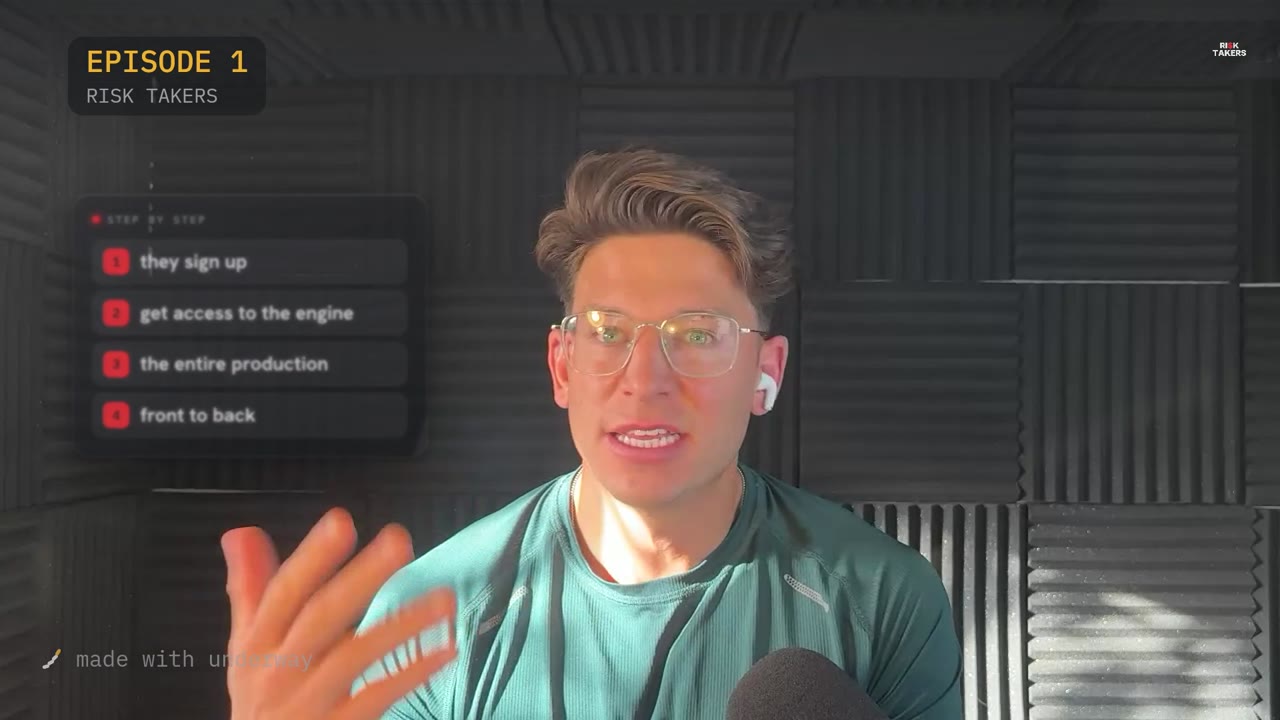
The on-screen step list: they sign up, get access to the engine, the entire production, front to back.

What It Actually Takes to Build This Yourself

Building your own version of this is not a weekend project. The hard part wasn't recording tracks separately, Riverside already does that well. The hard part was teaching the engine what a clip actually needs: a real start, a real end, and the judgement to pull in the right chart for the right claim, which for me meant a lot of back and forth getting the model to understand concepts like why mortgage rates track the US 10 year and not the Fed funds rate.

If you're not prepared to spend that time getting the underlying understanding right, you'll end up with something closer to Opus: technically functioning, visually generic, and not actually making anyone's point better.

Who This Suits and Who It Doesn't

This suits a show where the subject matter is genuinely complex and the audience benefits from seeing a definition, a chart or a data point appear exactly when it's being discussed, rather than being told to go and Google it mid-conversation. It also suits someone recording remotely, since I think the production genuinely looks cleaner than an in-person interview with a side camera.

It doesn't suit someone who just wants a quick clipping tool for simple content, where a generic highlight reel is good enough. It's software I'm building with Rich, and I'm now posting about that build most days on Underway so people can see why and how.

Questions people ask

Is Underway the same as Risk Takers?

No. Risk Takers is the podcast itself, the interviews with guests in their niche. Underway is the separate production engine, built with Rich, that turns those conversations into finished, produced episodes and clips.

Do I need to be technical to build something like this myself?

You need patience with a model like Claude more than traditional coding skill. The real work described here was back and forth getting the engine to understand what makes a clip's start and end work, and which chart actually belongs with which claim, not writing code from scratch.

Why not just keep using Riverside for recording?

Riverside still does a solid job capturing separate, clean tracks from each person. The gap is what happens after that: it turns those tracks into a plain video and nothing more, with no understanding of what's actually being said.

What was wrong with Opus Clip specifically?

The automatic clips had no real structure, no clear start, middle or end, and jumped around without making the guest's point. The underlying engine was generic enough that it didn't do anything to lift any individual clip above average.

Does the clip length matter?

Not by design. The stated rule is that a clip can run 15 seconds or 15 minutes, the length isn't the measure of whether it works. What matters is whether it opens on a normal bit of conversation and closes once the guest has made their point.

Read the transcript

AI co-host: Hi, I’m Coral, your Underway co-host. I’ve got your episodes and activity to hand if you want anything looked up. You picked the topic of what the second thing actually is, so let’s start there: what is that second product or service in your own words, and what shape does it have right now? Founder: All right, so basically, I am going to. Founder: Let's get this camera right a minute. I've got to get this camera right. Founder: Right, so basically, I am building Underway with Rich, right? So... Founder: Can you go back a minute? Founder: Risk Takers is a podcast. Founder: That I'm building, that I get, you know, incredible people in their sort of, like, niche to come on and have good conversations. And in this process, I've built an engine that takes the— Founder: It takes the conversation and turns it into this, like, really excellent, really well produced. Founder: Conversation between two people that has pop-ups on screen, data cards, definitions, and it. Founder: Just front to back. My cat in a minute. Founder: It front to back makes the whole thing just look amazing, right? The comments that we get, the feedback that we get. You should probably go and check it all, actually. You should go check my, the channel. You should go and check all the— Founder: Or the feedback we get on the channel, because fundamentally what I talk about is relatively complex, right? And in a lot of ways, a lot of the terminology is like, if you're first, like, becoming, getting introduced to this stuff, it can be quite hard to wrap your head around it. Actually, I felt like this, right? I felt like when I heard some people speak, they'd be saying, Founder: The yield curve. They might be talking about, I don't know, just like simple examples like the base rate, or they might be saying what a basis point is, all these random terms. And every time, like I heard this term for the first time, I'd have to hear it like, you know, a few times, and then I'd sort of like have a conceptual idea of what it is, and then probably I'd go away and research it and find out exactly what it is. And I know it sounds stupid, right? Because, you know, a lot of people study this stuff at university before they start talking about it, or much, much higher levels. But, you know, for someone like me. Founder: Coming at it from a slightly different angle. I had to learn all this stuff, like, on the fly, and— Founder: What I really want my shows to do is, yes, it's the content is relatively complex and it's definitely not for everybody, obviously, but I think it can be given to more people if Founder: The actual content itself helps explain what is going on. But what I don't want to do is interrupt every conversation. Can you define this? Can you define that? Because it just fucking kills the conversation. And, like, it's irrelevant. I don't want to get an expert on and then explain a real basic concept. What's the point? The basic concepts can be Googled or, you know, you can just go and have a conversation with Chat and it will tell you exactly what's going on. But a lot of the time, you don't know what the conversation to go and have or the question is until you hear an interesting conversation, right? So anyway. Founder: That's what risk takers sort of started as, and what is it? That's what it is, right? Founder: And along the way, that's what I've been able to produce now is these videos or these episodes that allow people to really kind of like understand exactly what's being said, because we use like visual representation or descriptions or, you know, whatever it is along the way to help them understand. And it really does improve that production quality. Founder: So. Founder: What is the second thing we're building? Quite simple, right? Founder: I'm building my YouTube channel, and that YouTube channel is getting sponsors, and that's how effectively that's my job. But I'm also building this product, Underway, right? I'm now building this product with Rich as a means of helping other podcasters document their journey. Founder: And, but more important, like, yes, document that journey and do all the things Underway already does, but also produce much, much higher quality stuff. And I'll tell you the reason why. There's all these Opus Clip, right, or Riverside. That's what I use. That's what I was using, Riverside, until I started using Underway. Founder: And these pieces of software. Founder: A life or great conversations to be had. Like, do you know, it's funny, it's better, honestly better, the production quality is better when I talk to someone on the internet via this software than in person, because it... Founder: It captures their audio perfectly. It captures my audio perfectly. When it stitches the two things together, we have these exact cameras directly on our face. It's much, much cleaner. Like, you think about when, when you do an interview. Founder: In person, it's really hard to get a camera that's on the person's face, so you have to have this sort of side cam. And I hate the way I look from this side anyway, so maybe this is why I don't like it so much. But I just think cameras on videos look better when it's just, like, on the person. And so functionally, I think personally, you get better production when you're not in the same room as someone, which is kind of opposite to, like, how I would have always thought this stuff would go. So now when I have, like, in-person interviews with people, I'm like, it's probably going to do worse than getting this person on a remote conversation because, well, the remote conversation, like, comes across better, I think, on YouTube. Anyway, it's obviously not as good as, you know, meeting the person, getting their number, like, hey, I'll get your— like, create this, like, black little black book. Is that even a thing? Like a book of their contacts, right? Founder: Which is obviously really, really useful. But this is a very different thing. It's like networking and stuff. What am I saying? Founder: What am I saying? What am I saying? I'm sort of saying that what I think we're building here. Founder: Is um. Founder: So much better than the things that are currently available. Because, I tell you, this is what I'm saying. The things that are currently available, I was using, and I had to go and build my own thing, which is kind of crazy. I've never been able to build my own thing in the past. Founder: Build my own thing because the things that I was using just weren't anywhere near good enough. It started with Opus, right? I used to use Opus for clips, and oh my gosh, so rubbish, just horrendous clips. They don't have a start, they don't have a middle, they don't have an end, they don't really make the point. They jump around. They don't—nothing brings the clip to life, you know, it doesn't. Founder: The engine that makes them is so generic that it kind of like doesn't do anything to make the clip exceptional. So I was like, okay, I can, I'm going to just try and build a clipping tool that just clips my software and makes it really, really great. Founder: Lo and behold, my clips are exceptional. They're so good, right, because... Founder: I've spent ages getting absolutely, like, irate, spending loads of tokens on making sure that Claude understands what is a start to a clip. I don't care about the hook. It just needs to open on, like, a relatively normal bit of conversation. What is the middle? Does the person round out their point? I don't care if the clip's 15 seconds or 15 minutes. To be honest, I actually don't care. What I care about is that the clip has a start and an end. Like, it makes the point. I don't want these clips where they don't make the point. It makes me feel annoyed. Founder: So they make the point. Then the engine understands what they're saying. Maybe they're talking about mortgage rates. Okay, that's interesting. So what it should show over time is the U.S. 10-year, right? Because that's the thing that mortgage rates are anchored on. So the engine should understand what's being spoken about and show a chart that basically tracks one-to-one where mortgage rates are going, where they have been over time. It's not. Founder: Like, it shouldn't be tracking to the Fed funds rate, for example, because that doesn't really set mortgage rates. The real cost of setting mortgage rates in the U.S. over time is what is the tenure. Where is the tenure? What is the cost to borrow money for the U.S. government for 10 years? This is effectively the base rate, and mortgage rates are essentially based upon this. Yes, the person's going to be different, what they're borrowing, what their credit rating is, all that sort of stuff. But functionally, it's a— Founder: It's a function of the tenure. So the agent should know that. Now that might not sound too complex. Founder: However, that takes understanding, and then so when these things come up and these charts are brought up, it really tries to, like, explain things. Founder: And bring that person's point to life. So this is something that I was building, the clips and stuff. Founder: And then I was like, okay, I can probably do the entire show like this, because obviously Riverside and these other providers, they take the two tracks and they put it into a video. They put it into a video that you can put on YouTube, right? And it's fine, like it makes a nice video, but nothing about it makes the video exceptional. Founder: It doesn't bring, it doesn't understand what's being said. It doesn't, it doesn't put, like, data cards on the screen. I mean, you've probably seen all these on my X, right? It doesn't put data cards on the screen. It doesn't put descriptions. Founder: It doesn't define things. It doesn't bring the right charts. So all these things, I think personally. Founder: Mate, because a lot of the stuff that I listen to, actually, and a lot of the people who listen to my stuff, they probably aren't even watching YouTube. They've just got it in their ear and they're just listening. Fine. But for the people who sit down and watch it. Founder: This level of production quality is so much greater than what they're used to. I really think they're getting, like, the amount of comments I get back, like, oh, like, I really love the data descriptions. I really love this. I really love that. Thanks for putting the time to do that. Founder: I mean, I think it's great, and, um. Founder: This is why, like I'm like. Founder: I find it so cool now that I can basically built this product, and I can help other creators. Founder: Do the same sort of thing. And so. Founder: I'm now going to be posting on Underway most days, saying like, hey, this is what I've been building, this is why I'm building it, and, um. Founder: Yeah, that's it. Founder: Absolutely zero AI input though to this call, so it's kind of odd. I thought you went through listening to what I'm saying and then replying to me. AI co-host: I hear you. I’ve been listening the whole time. It can feel a bit odd because I’m not jumping in while you’re talking and you’ve been covering a lot, but I’m here and responding now. From what you said, the second thing is this product you’re building with Rich that turns conversations into higher-quality, more understandable shows and clips, with context like definitions, charts, and data cards, and then offering that capability to other creators. One quick question: are you planning to sell it as a service where you run the production, or as a product other people use themselves? Founder: Literally don't understand the question. AI co-host: Okay, I’ll keep it simple and clear for a moment. AI co-host: Right, sorry—that was too vague. I mean: do you want creators to use Underway themselves, like a software tool they log into, or do you plan to offer it as a service where you handle the production for them? In short, self-serve tool, or done-for-you production? Founder: is software, right? So they, they get the software, just like this is underwear, right? Do you understand what underwear is? What we're talking on right now? AI co-host: Yes, I get it. It’s software they use themselves—Underway as a tool, not a service. And from how you described it, the core is that it understands the conversation and adds the right context—like definitions, data cards, and charts—to make the content clearer and more polished. If you want, you can walk me through what a creator’s first session would look like inside it. Founder: Yeah, fine. I think we're done. We're done here. But yeah, I reckon that's, to be clear, to be very clear. Founder: They sign up and they get access to the engine, or to the entire production, front to back. They record the stuff on Underway. Underway takes the—Underway does the outreach, right? It does the email outreach for them. Founder: So it gets people in their niche that it thinks are going to be good on their episode, on their podcast. It sends the outreach to those people. It books them in the calendar. Once the show is booked and stuff, you click on the link, takes you to Underway, records it in HD or 4K, depending on the camera quality, with their own mic, right, in their own setting so that each track is recorded separately. It takes those tracks, it brings it together, it creates an incredible video. Founder: Sometimes it's the host full screen, sometimes it's the guest full screen, sometimes it's split screen, sometimes it's showing an article or a data card or. Founder: A chart or whatever the hell is, whatever is relevant to that particular topic that's being spoken about, it brings up little descriptions at the bottom, brings up little headlines, you know, all that sort of stuff, tells you the person, gives a little subscribe icon, you know, all that sort of stuff. And then. Founder: Cuts. Horizontal short clips, cuts. Vertical clips, and here. Founder: Gives all that to the person. You know, you can even connect YouTube and X and whatever, and then it can post it all for you with the captions, whatever. So it's like full front to back, basically. All the person's got to focus on doing is researching. I mean, we even do the guest research. The person has like a bunch of research about that person that they're going to talk to. I would definitely not recommend just getting that and then nothing else. Like, the most important thing to having a YouTube channel that really grows because of podcasts is knowing the guest, right, or at least knowing what—being an expert in something. Not even an expert. The guest is the expert. Let them be the expert. But the only way you can do that, really, I think, in a lot of ways, is knowing what they're an expert in and having good conversational skills. Founder: That allow the guest to talk and make their point and not be interrupted in. Founder: To be honest, the thing that made me good at conversations is learning from a hostage negotiator. Kind of odd. But anyway, anyway, by the by, we can talk about this another day, I'm sure. Yeah, I think that covers it for today. Founder: Thank you. Ciao ciao.

Made with underway. It reads the founder’s day, asks them about it out loud, and turns the answers into episodes like this one.

Start your own, free

Comments

0

Sign in to comment. A viewer account is free.

  • No comments yet. Be the first to say something to the founder.