
Article
build in public with no audience: why it still pays
30 September 2026 · 8 min read
Post on Xthe short version
if you build in public with no audience, you are not doing it wrong. almost everyone starts by posting into silence, often for months. the mistake is judging it by the likes on episode 3, which measures reach you do not have yet, at the moment it matters least.
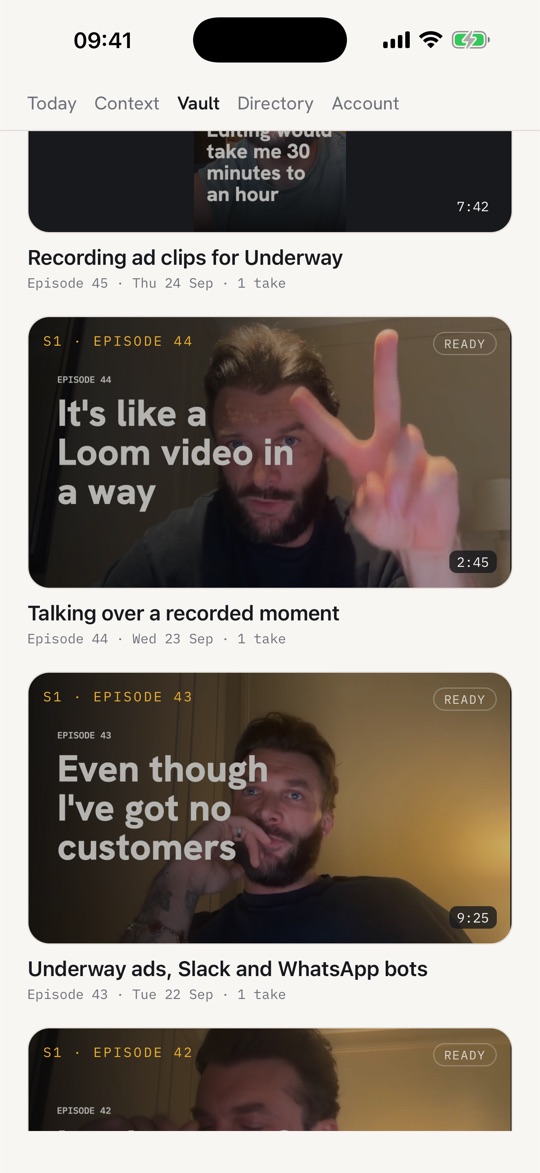
what you are really making is an archive: a numbered, dated record of a thing being built. its value arrives later. new viewers start at the beginning. an investor or a hire can read eighty episodes of how you work. on launch day you have an origin story on camera, which nobody can make afterwards.
so the practical answer is: count what accumulates rather than likes, make each episode cheap enough that silence costs you little, put the series where people go looking for builds, and if you are not ready to be watched at all, record anyway and publish later.
why building in public when nobody is watching feels pointless
the question on product hunt and indie hackers is always some version of "what's the point if nobody's watching?" it is a fair question. social platforms are built around a feedback loop: you post, people react, the reaction tells you it was worth it. with no followers the loop returns nothing, so every post feels like effort thrown into a hole.
the personal essays that rank for this mostly land on encouragement: keep going, it compounds, the algorithm will notice eventually. some of that is true. audiences do build slowly, and plenty of people quit before the slope has a chance to change. but "keep going" is not a reason, and it does not tell you what you are getting on the days nobody watches.
the better answer is that the audience was never the only thing being made. posting into silence at episode 3 is one of the most common reasons people give up on building in public, and it is a reasonable reaction if you think each post is only worth its likes. it stops being reasonable once you see what the pile of episodes is for.
what an archive is worth when you build in public with no audience
a one-off post is judged the day it goes out and then it is gone. an episode in a numbered series keeps a job. it is one part of a story that somebody can pick up from the start at any point in the future. the people who will read it later are different from the people scrolling today:
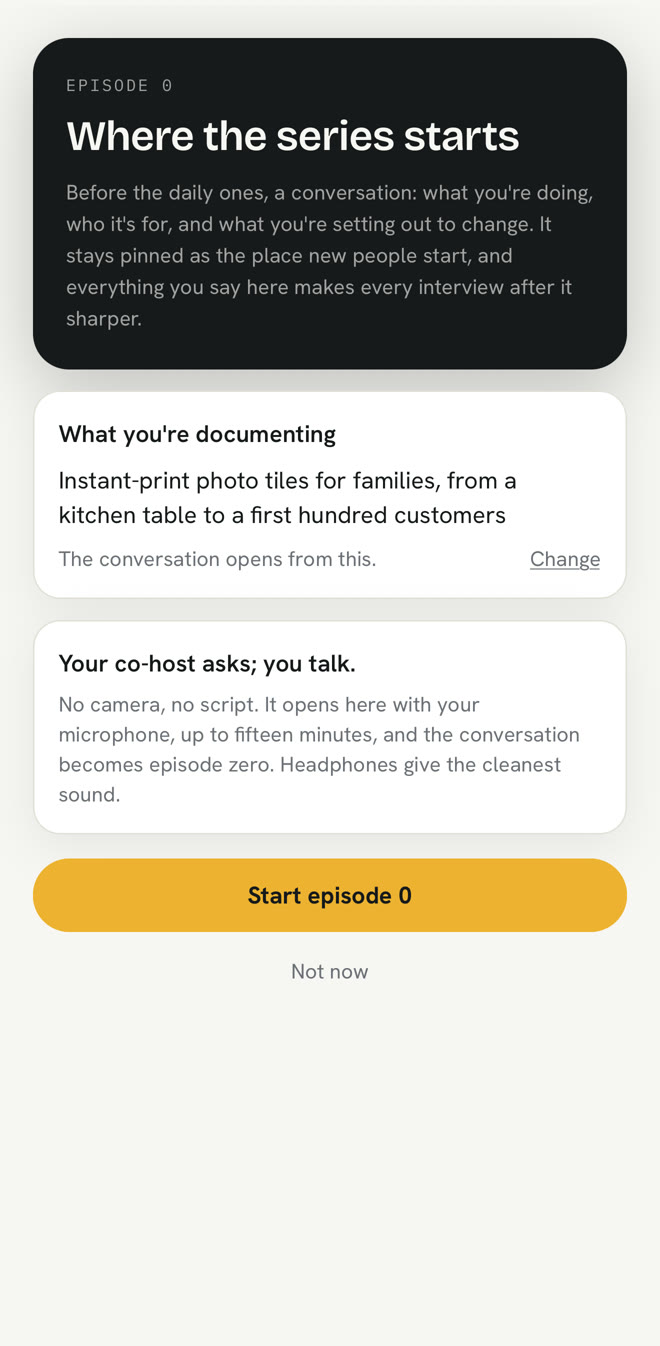
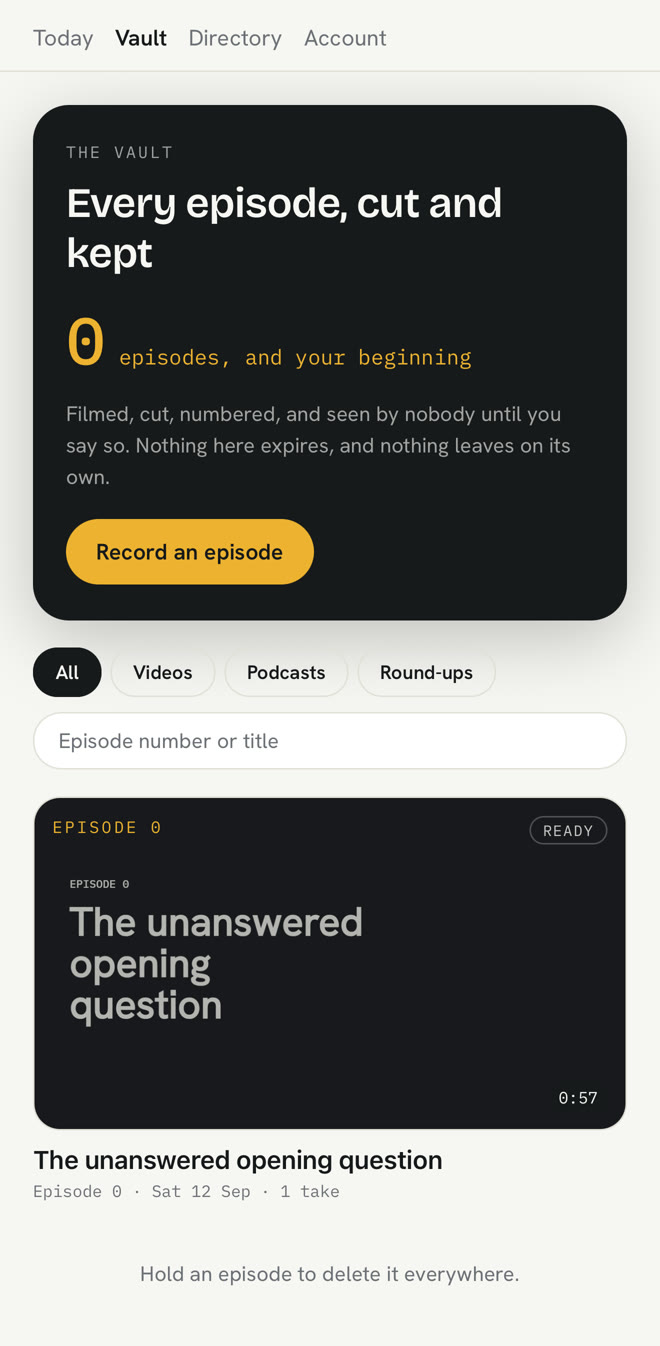
- new viewers. nobody arrives at episode 47 and scrolls back to 1 through a feed. they start at the beginning, if there is one. in underway every series opens with episode zero, a conversation about what you are building, who it is for and where it stands, and it sits at the top of your page under Start here.
- investors. eighty episodes is the most thorough due-diligence artefact a founder can hand anyone: how you think under pressure, over eighty days, with nothing reordered and nothing invented.
- hires. someone deciding whether to join can watch how you handle a bad week, which no job description tells them.
- customers. someone who watched the fix get made tends to trust it more than someone who read the changelog.
- you. the archive answers questions you will have forgotten: when did we add that, what did i say the price was in july. underway's Ask the vault reads it for exactly that.
- launch day. if you have been filming since the start, the origin story already exists, in order, in your own voice.
| a one-off post | an episode in a numbered series | |
|---|---|---|
| with no followers | seen by almost nobody, then buried | seen by almost nobody, then kept in order |
| to someone who finds you in month six | one of hundreds of scattered posts | episode zero to now, numbered, with dates |
| to an investor or a hire | a highlights reel | how you worked, week after week |
| on launch day | a thread written that week | the origin story, filmed as it happened |
| what it asks of you | a fresh idea each time | a few minutes answering about today |
count what accumulates, not likes
a like count on episode 3 is a measure of reach you do not have. it will be low, it will feel like a verdict, and it tells you almost nothing about whether the series is working. measure the things you control, and the things that only grow:
- episodes made. the number on the front of each episode is the whole scoreboard. episode 30 exists and episode 3 did not know it would.
- your streak against the commitment you chose. weekdays, three a week, whatever you picked, with a pause for when you are away.
- threads that resolved. a problem raised in episode 12 and fixed in episode 15 is a story, and stories are what bring people back.
- the first stranger who says they watched from the start. it is usually one person, and it is worth more than a hundred likes.
underway is built around this. it acknowledges what has accumulated (a week straight, thirty episodes) and never counts down to a target. the audience numbers it has, like how many people follow your series, are shown to you, because you need to know, but they never reach the interviewer. the questions you are asked are never steered by what performed last week, which is how a series stays honest when the numbers are small.
how to build in public with no audience: make silence cheap
silence only hurts in proportion to what each post cost you. if an update takes an hour of deciding, filming and editing, getting no response to it is painful. if it takes three minutes of talking, it barely registers, and you are far more likely to still be there when people arrive.
that is the main job of underway. it reads what you connect, read-only, and asks you out loud about the day you actually had, one question at a time. a standard episode aims for about three minutes of answers and stops at five. the cut, captions and your episode card are made for you, and the words for each platform are drafted from what you said. episodes are counted, not days, so a missed week never leaves a hole.
it also helps to stop addressing the crowd you do not have. "hey everyone" to zero people feels absurd, and it sounds it. talk to the one person who will find the series in six months and start at the beginning. name the thing you worked on, say the number, say what went wrong. that person needs context, not energy.
put the series where people look for builds
feeds rank by recency and reach, so at zero followers you are close to invisible there. that is worth knowing rather than fighting. keep posting to the feeds, but also put the series somewhere built for series, where someone browsing is looking for exactly what you are making.
every public underway series has a page of its own, episode zero first, every episode in order, and a podcast feed. the directory is the index over all of them. it ranks series, never episodes, and it has more than one front door on purpose: Longest running, Longest streak, Filmed recently, Newest series and Most followed, and it can be browsed by industry, which is read from the line you wrote about what you are documenting rather than a picker. a new series on episode 3 can be found through Newest series or Filmed recently, not buried under whoever is biggest.
anyone can follow a series from its page, by account or by email, and gets at most one email a day, only on days you release something. and joining while the directory is small is a real advantage: attention is easier to win in a room with few series in it, and it will not always be that room.
you are not alone in the silence either. the underway community, free and needing no plan, opens a thread every day asking who filmed today, and your published episode lands in it on its own. on mondays it posts the standings, ranked by consistency and nothing else. nobody should film episode 3 by themselves.
not ready to be watched? record anyway
some people searching for this do not want an audience yet. a stealth product, an unannounced pivot, a job not yet left. the answer is not to wait, because footage of this period is the one thing that cannot be made later.
in underway every episode stays in the vault until you send it. a series can run in stealth for months: same interview, same numbering, nothing leaving the app. on the day you go public, the vault can be released in one go, oldest first, each episode carrying the date it was filmed, onto your page and your podcast feed, which are built to hold a back catalogue. the feed gets one launch post, not forty. any episode can be held back for good.
faqs
is it worth building in public with no audience?
yes, if you treat it as building an archive rather than chasing reactions. the early episodes are the ones every future viewer starts from, and the record is useful to investors, hires and you whether or not anyone watched at the time.
how long until people start watching?
there is no honest number. it depends on what you are building, who it is for and where you post. what is reliable is that people who stop at episode 3 never find out, and that a low-cost habit is the one that survives long enough to.
should i build an audience first and then build in public?
building in public is one of the ways you build the audience, so waiting for one first tends to mean never starting. if you are not ready to be seen, record privately and release the archive later.
where should i post if i have no followers?
wherever you already are, plus somewhere built for series: your own series page, a podcast feed, and a directory of builds. communities that expect regular updates, like r/buildinpublic once a week, also work better than a cold feed.
what if nobody ever watches?
you still have a dated record of how you built something, in your own words, that you can search, hand to an investor or a hire, or keep for yourself. the raw footage is downloadable on every underway plan, free included.
how much does underway cost?
three episodes are free, no card. Founder is £29 a month or £290 a year. Series is £79 a month or £790 a year.
where to go next
recording in private now and releasing it all at launch: /coming-out-of-stealth-mode.
why an archive is due diligence an investor can actually read: /due-diligence-video-archive-for-founders.
building in public without living on X: /build-in-public-without-twitter.