
How do you find your ideal customers for a daily build-in-public tool?
by Richard Lovatt · updated 19 October 2026
Find them where they already describe the problem out loud. Underway's Conversations, in the Promote tab, searches X, LinkedIn, Reddit, Threads and Hacker News every day for people saying in their own words that they have the problem you solve, sorts them by platform, and gives you the link, the context, how it was found and what you could say. Nothing is posted for you.
In short
- People with your problem are already posting about it; the work is finding the few posts worth a reply.
- Conversations runs a daily search across X, LinkedIn, Reddit, Threads and Hacker News, platform by platform, each term in quotes.
- It reads what it finds and passes over posts without enough context, so you read a shortlist, not a feed.
- Each signal comes with a drafted reply: helpful, no link, no pitch, never your product's name.
- It is only as good as your marketing brief, so give it your website and as much context as you can at setup.
The real problem: your buyers are posting about it, you just are not there
Everyone tells you to find your ideal customers. Nobody tells you where they are at four o'clock on a Tuesday. The honest answer is that they are typing the problem into a social feed, in their own words, with no idea a product exists for it. Someone writes that they spent hours editing a video and then never posted it. Someone else writes that their one regret is not documenting their wins as they went. Those are buying signals, and they scroll past you because you were building.
The second half of the problem is scale. Searching five platforms by hand, every day, with the right phrasing on each one, is a job. Do it manually and you either skip it entirely or you burn an hour reading posts that turn out to be irrelevant. The thing that kills it is the same thing that kills documenting: friction.
That is why I built this into the same app I document in. For me, this whole app is you're documenting on one side, and you've got your promotion and marketing channels on the other side, and it makes both incredibly simple for you. One place to record what happened today, one place to go and find the people who need what you are making.

Where Conversations sits: the Promote tab and the shop window
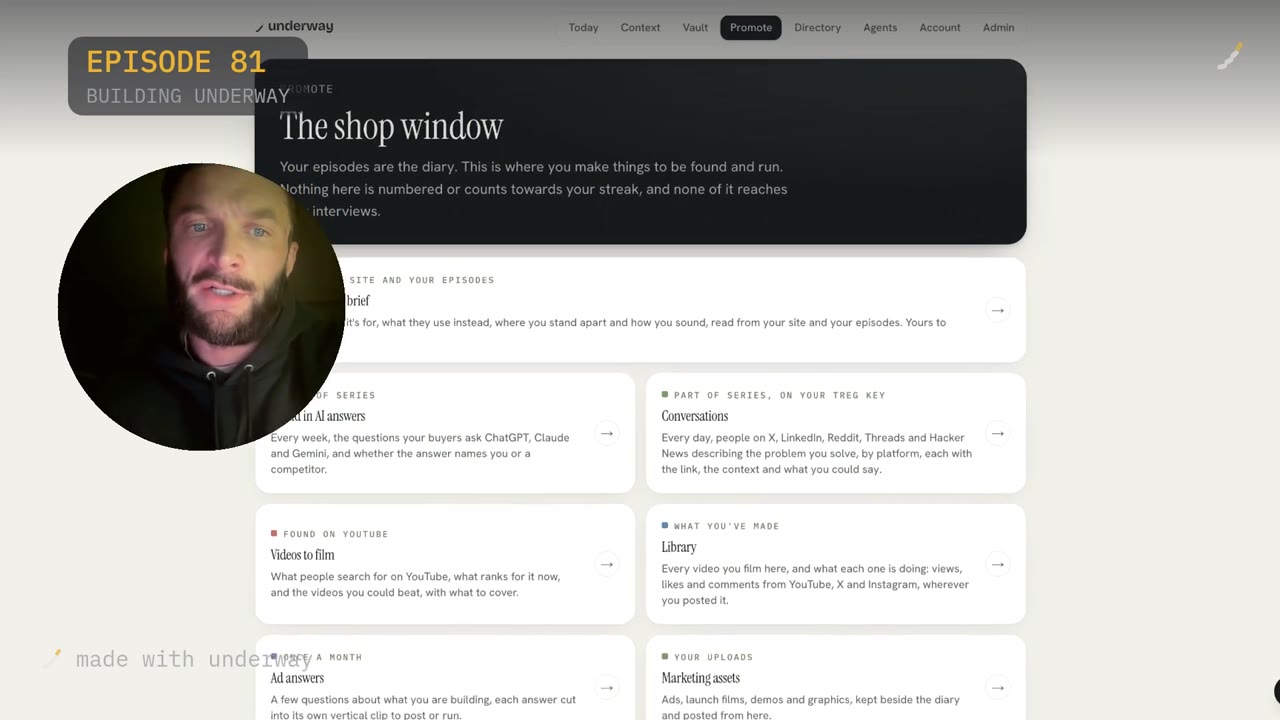
In Underway, your episodes are the diary. Promote is the shop window: the things you make to be found and to be run. Nothing in there is numbered, nothing counts towards your streak, and none of it reaches your interviews. It is deliberately kept apart from the record you are building.
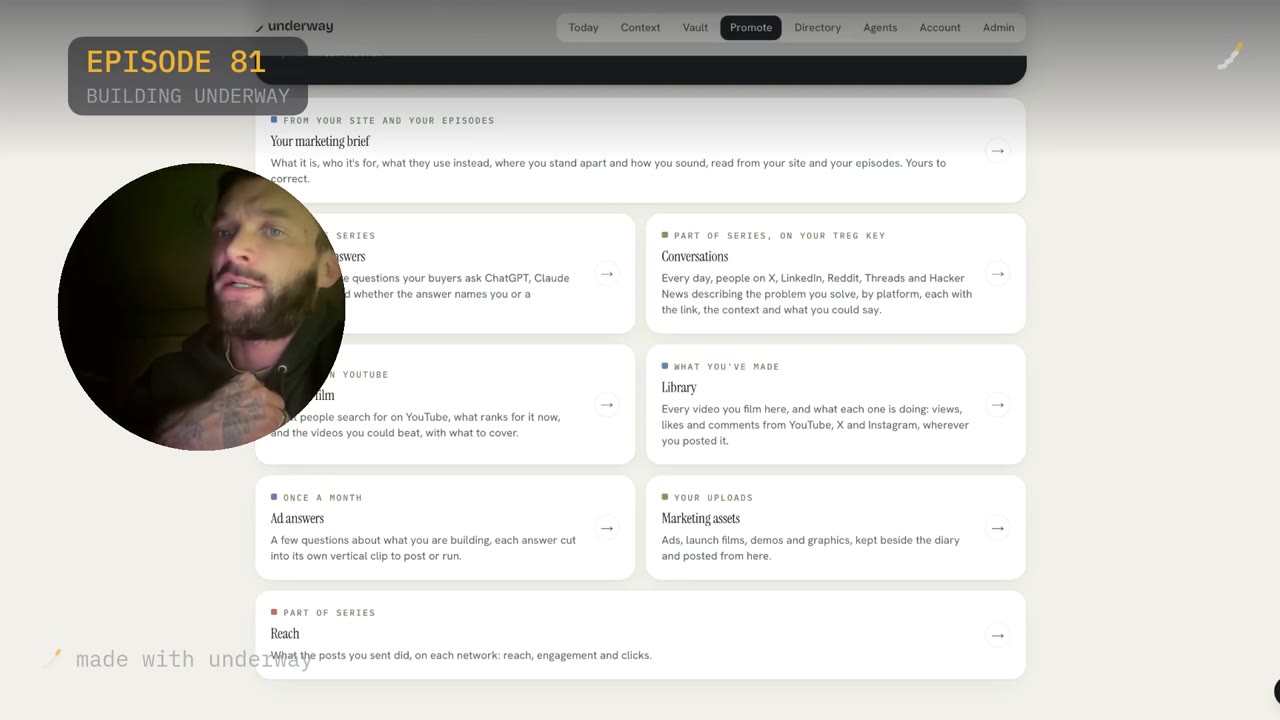
The shop window holds your marketing brief, written from your site and your episodes and yours to correct. Found in AI answers, which every week puts the questions your buyers ask to ChatGPT, Claude and Gemini and tells you whether the answer names you or a competitor. Videos to film, what people search for on YouTube. Library, every video you have filmed and what each one is doing. Ad answers, marketing assets, and Reach, which shows what the posts you sent did on each network.
Conversations is the one marked part of series, on your own key. Found in AI answers and Conversations are both on the top membership. Everything else in the shop window sits alongside them, so the day's reply list and the day's episode live in the same app.
How Conversations works, step by step
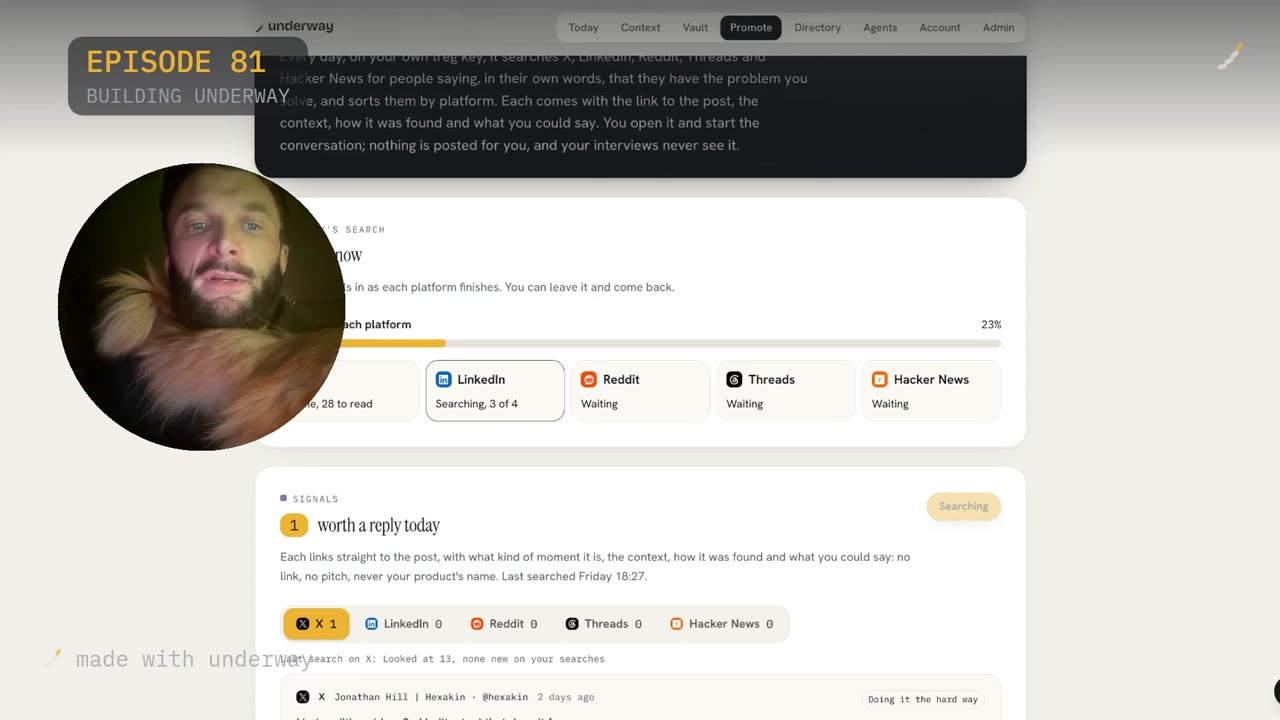
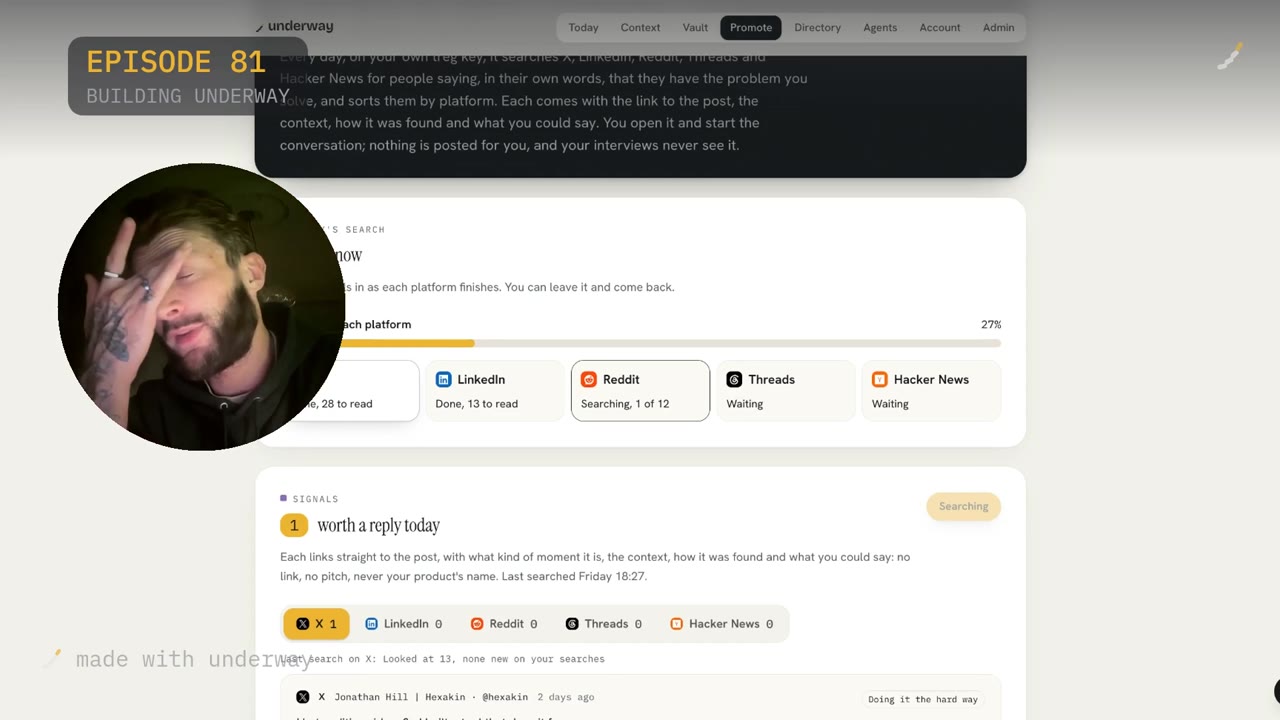
Every day, on your own key, it searches X, LinkedIn, Reddit, Threads and Hacker News for people saying, in their own words, that they have the problem you solve, and sorts them by platform. Each one comes with the link to the post, the context, how it was found and what you could say. You open it and start the conversation. Nothing is posted for you, and your interviews never see it.
Open the page and it fills as each platform finishes, so you can leave it and come back. On the run I filmed, X finished first with 28 to read, then LinkedIn done with 13, then Reddit with 33, with Threads and Hacker News still waiting. A progress bar moves through them. One of the platforms came back with Couldn't search, which happens.
The search itself is built platform by platform: one moment, said a few ways, each in quotes and joined together. On X that was people saying they wish they had filmed, wish they had recorded, wish they had documented, should have filmed, or that editing takes forever, or that they never know what to say. On LinkedIn, wish I had documented and struggling to post consistently. On Reddit, building in public. It is not always spot on, but people saying that kind of thing are probably close to what I do.
It does this by itself, which is exactly why the setup matters. Do the marketing brief, give it your website, give it as much context as possible so it understands what your buyers' issues are and what to look for. The search terms are written from that brief. Vague brief, vague search.
Filtering: why a shortlist beats a firehose
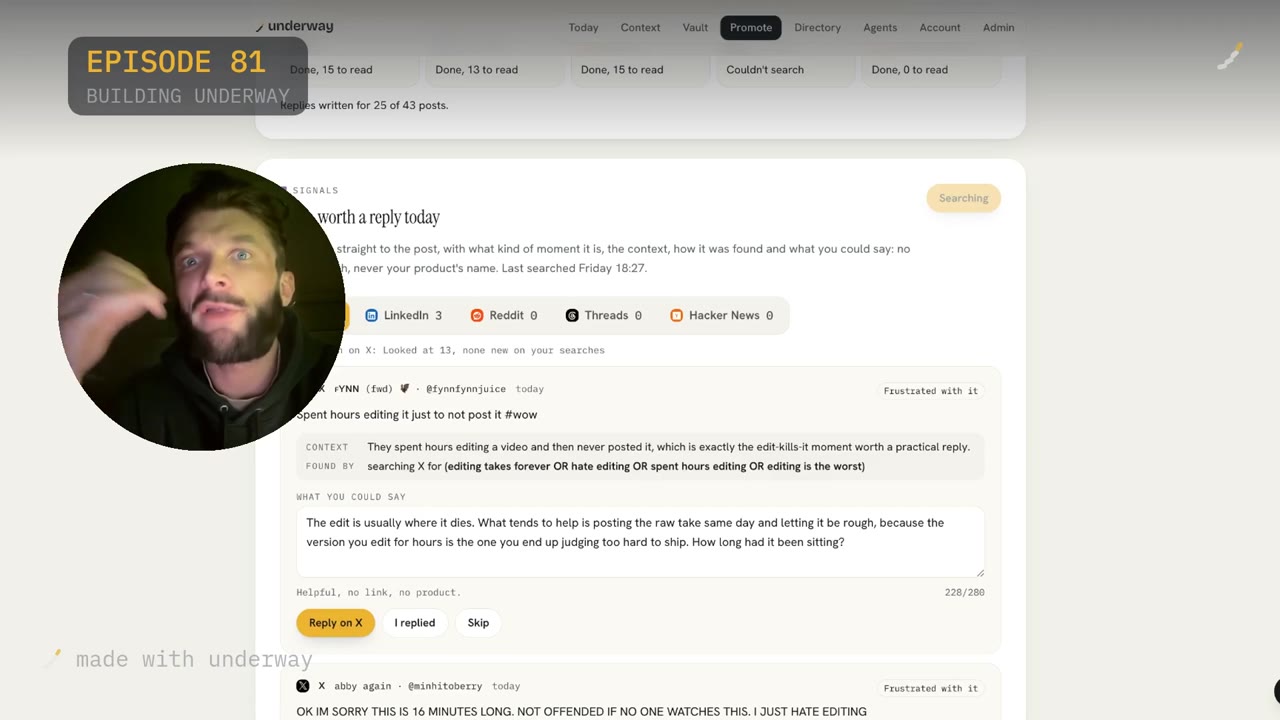
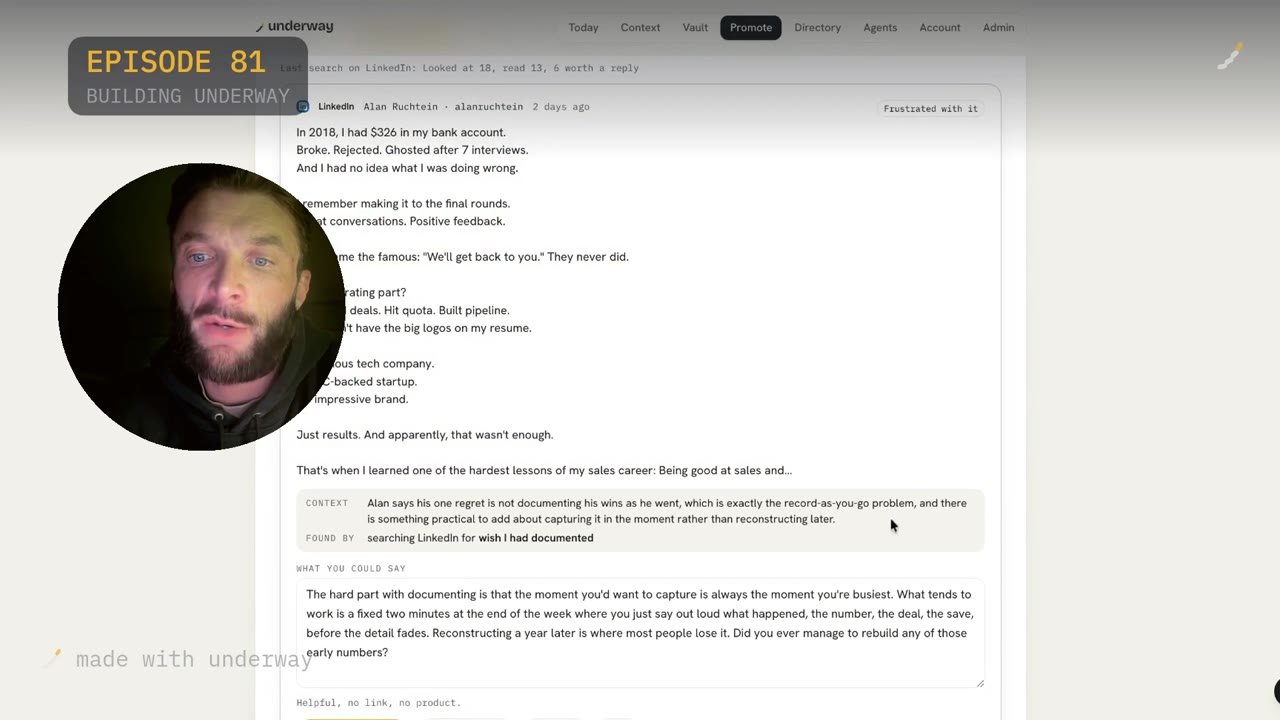
Scanning five platforms produces far too much. The second pass is the one that matters: it reads what it found and decides whether the post is actually worth replying to, because the context has to be there, not just the phrase. On X it told me plainly that it looked at 13 more and passed over them. On LinkedIn: looked at 18, read 13, 6 worth a reply. Replies were written for 25 of 43 posts on that run.
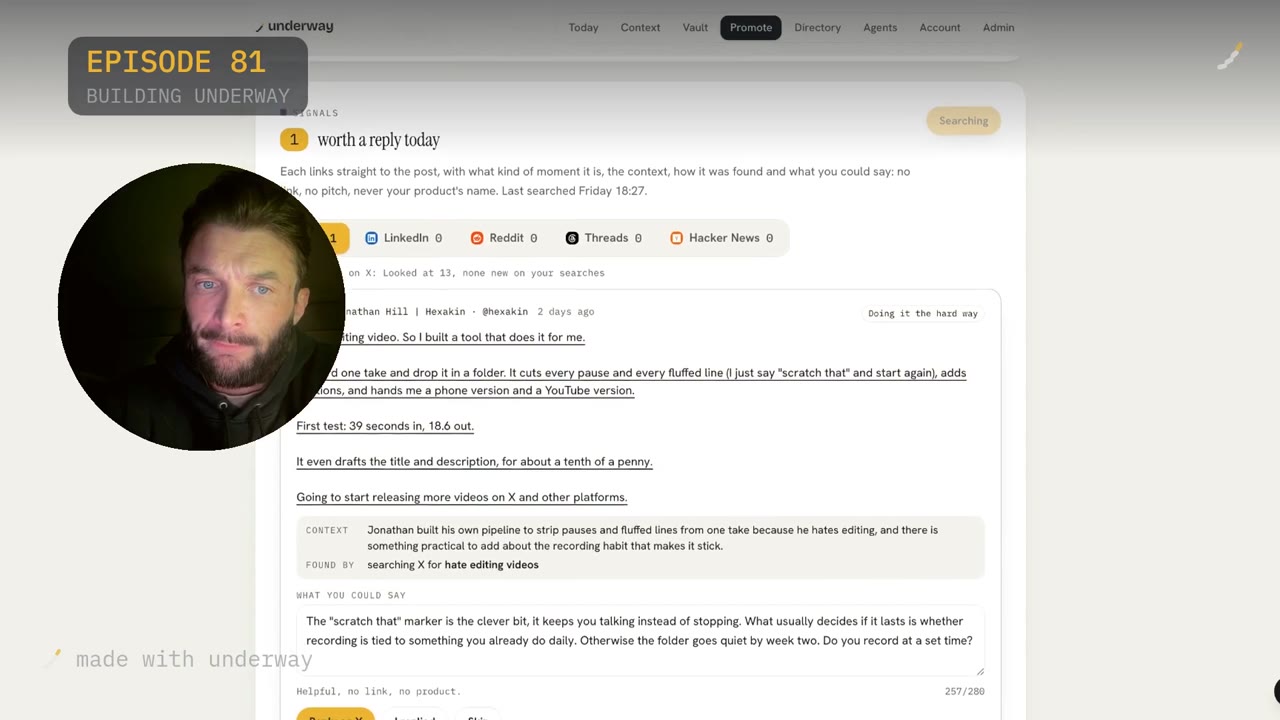
You still have to use your judgement. The first thing it surfaced that day was worth a reply but was clearly a competitor: someone who hates editing video so they built their own tool for it, 39 seconds in and 18.6 seconds out. Look, this tool is not going to be spot on every time. Some of the people it finds will not be founders at all, which does not mean Underway cannot help them.
Each signal is labelled with the kind of moment it is: frustrated with it, doing it the hard way. One from X read that they spent hours editing a video just to not post it, tagged as the edit-kills-it moment worth a practical reply, found by searching X for a cluster of editing complaints. Another said sorry this is 16 minutes long, not offended if no one watches, I just hate editing. These are not leads in a CRM, they are people mid-complaint.
The reply it writes for you, and why it has no link in it
Under each post it drafts what you could say, with a character count against the platform's limit, and the rule printed underneath: helpful, no link, no product. For the person who spent hours editing and never posted, the draft said the edit is usually where it dies, that posting the raw take the same day tends to help because the version you edit for hours is the one you judge too hard to ship, and ended with a question: how long had it been sitting.
You get three buttons: Reply on X, I replied, or Skip. Press reply and it carries the words through to the platform, where you post it yourself. It does not post on your behalf, and none of this reaches the interviews that make your episodes.
The point of a reply with no link is that it has to survive on its own. You are adding something practical to a thread, not pitching. If the person wants to know who you are they can look, and that is a far better first contact than a cold message.
When it finds the exact customer
The one that made the run worth filming came from LinkedIn. Alan had written about 2018, $326 in the bank, broke, rejected, ghosted after seven interviews, final rounds and positive feedback and then we'll get back to you. He had closed deals, hit quota, built pipeline, but no big logos on his resume. Just results, and apparently that wasn't enough.
The context Underway put under it said his one regret is not documenting his wins as he went, which is exactly the record-as-you-go problem, and that there is something practical to add about capturing it in the moment rather than reconstructing later. Found by searching LinkedIn for wish I had documented. That is literally my exact customer.
The drafted reply said the hard part with documenting is that the moment you'd want to capture is always the moment you're busiest, that a fixed two minutes at the end of the week saying out loud what happened tends to work, and that reconstructing a year later is where most people lose it. Then a question: did you ever manage to rebuild any of those early numbers.
On Reddit it found someone nine months into building a trading alert bot, posting a long written progress update as a follow-up to an earlier one, flagged as the slow manual way of keeping a record of building. Same problem, different words, different platform.
What it costs in time, and why it counts as semi-free marketing
The search runs itself while you do something else. Your time goes on reading the shortlist and sending the replies you agree with, which is minutes rather than an afternoon. Yes, you are paying for Underway, but this is semi-free marketing. Doing it every day, across all of these signals from people saying they have the problem you have a solution for, is how finding your first few customers can be done.
Compare that with the usual options. Cold outreach to people who never said they had the problem converts badly and makes you feel awful. Paid ads work but cost money every day and you are guessing at the audience. Posting into your own feed and hoping reaches whoever already follows you, which when you are starting is nobody. Hiring someone to do the searching gives you a second person's guess at your buyers.
It suits anyone selling to people who talk in public about their work: founders, makers, anyone whose buyers post on X, LinkedIn, Reddit, Threads or Hacker News. It suits you less if your buyers never post, or if you want a tool that fires off messages automatically, because nothing here is sent for you.
One place for documenting and for finding customers
I work in marketing and sales, so this part comes naturally to me. What changed is that the documenting now happens in the same place and takes no more effort. Underway reads your day from the tools you already use, interviews you out loud about what changed, and hands back a finished numbered episode with no editing. Then the Promote tab takes the same understanding of your business and goes looking for people with the problem.
The two halves feed each other. The marketing brief that gets written from your website and your episodes is what the search terms come from. The episodes you record become the thing a person can go and watch after you have replied helpfully to their post. Neither works as well alone.
This is a one-stop shop to help you document your business and also propel it forward in terms of promotion, marketing and finding customers. That is what finding ideal customers looks like for me at this stage: a daily shortlist of real people, in their own words, with something useful to say back.
Questions people ask
Which platforms does Conversations search?
X, LinkedIn, Reddit, Threads and Hacker News. It runs them platform by platform and the page fills as each one finishes, so you can leave it and come back. Occasionally one of them comes back with Couldn't search, and the rest still complete.
Does it post or reply for me?
No. It drafts what you could say and gives you a button to reply on the platform, where you post it yourself. Nothing is posted on your behalf, and the signals and replies never reach the interviews that make your episodes.
Why do the drafted replies never mention my product?
Each draft is marked helpful, no link, no product. A reply that adds something practical to the thread survives on its own and does not read as a pitch. If the person is interested, they can look you up, and that is a better first contact than a sales message.
How does it know what to search for?
From your marketing brief, which is written from your website and your episodes and which you can correct. That is why the setup matters: give it your website and as much context as possible so it understands what your buyers' problems are. The searches are one moment said a few ways, each in quotes, built per platform.
Does it find only perfect matches?
No, and it says so. On one run it surfaced a competitor as worth a reply, and some people it finds will not be founders at all. It does read what it found and passes over the posts without enough context, so you get a shortlist rather than everything it scanned, but you still apply your own judgement.
Is Conversations on every plan?
Conversations and Found in AI answers are both on the top membership. The rest of the shop window, including the marketing brief, Videos to film, Library and marketing assets, sits alongside them in the Promote tab.
How is this different from just searching X myself?
You can do exactly this by hand. The difference is that it runs five platforms every day with the right phrasing on each, reads the results, discards the ones without enough context and drafts a reply for the rest, so your time goes on judging and sending rather than searching and reading.