
New in underway
how to introduce yourself on your first youtube video
8 October 2026 · 8 min read
Post on X
how to introduce yourself on your first youtube video: say your name, say what you are making or doing in one plain sentence, say who it is for, say honestly where it stands today, and say what the channel will follow from here. thirty seconds to a minute covers it. then stop introducing yourself and give the viewer the first real thing.
the words are rarely what goes wrong. the delivery is. most first videos are someone staring into a lens, reciting a bio they wrote the night before, and it sounds like it. the easiest fix is not a better script. it is to be asked, and to answer like you would answer a person. that is how underway's first video, episode zero, works, and it is further down this page.
how to introduce yourself on your first youtube video: what to say
five things, roughly in this order. none of them needs more than a sentence or two.
- who you are: your first name, and the one fact that makes you the person to make this channel. not your whole cv.
- what you are making or doing: the business, the project, the skill, in words a stranger would understand.
- who it is for: the people you hope are watching. naming them helps the right ones stay.
- where it honestly stands: day one, ten customers, a shop that has run for years and is trying something new. honest beats impressive, and it is the line people remember.
- what comes next: what the channel will follow, and roughly how often you plan to post. promise what you can keep.
page one for this search mostly says the same: keep it short, show who you are, give people a reason to stay. that is right. what it leaves out is how to get the words out of you without sounding rehearsed, which is the part this guide spends the most time on.
prompts to answer in your own words
rather than writing a script, write down these prompts and answer each one out loud, as if someone across the table had asked it. record the answers, not a reading.
- what are you building, in a couple of sentences?
- who is it for, and what do those people do instead today?
- where does it honestly stand right now?
- what is the hardest part so far?
- what comes next, as far as you can see it?
an answer to a question names its subject and gets to the point. a piece to camera drifts into marketing language, because there is no one to answer to. if an answer comes out sounding like your landing page, say it again more plainly.
what not to do in your first video
- do not tell your life story. one fact that earns you the right to talk about this is enough.
- do not apologise for being new, for the camera, or for the lighting. everyone starts somewhere and viewers know it.
- do not ask people to subscribe before you have given them anything. give them the first real thing, then ask.
- do not read a script off the screen. your eyes move and it shows.
- do not promise a schedule you cannot keep. a daily promise broken in week two is worse than a weekly one kept for a year.
- do not pitch. a first video that sells is one people click away from.
how long should your first youtube video introduction be?
the introduction itself: under a minute. the whole first video can be longer if it carries something worth watching. there are two good shapes. one is a short channel intro, a minute or two, which you can use as the channel trailer. the other is a longer first episode, five to ten minutes, where the introduction is the first part of a real conversation about what you are doing and why.
the second ages better. a year later, a new viewer can start there and hear where it all began, in your own voice, before any of it worked out. that is the video people go back to.
how to sound like yourself on camera
- have someone ask you the questions, out loud. a friend, a co-founder, or an interviewer in an app. you answer a person differently from a lens.
- look at the lens when you answer, not at your own face on the screen.
- do one practice run you throw away. the second go is always looser.
- sit, if you would normally sit. standing to deliver something is how people start to perform.
- stop when you have said it. a first video that ends while you still have something to say is one people come back for.
light, sound and framing in five minutes
- face a window, never sit with your back to one.
- put the phone or camera at eye level on something steady: a stack of books, a shelf, a tripod. a hand-held camera wobbles.
- get close to the microphone, or wear headphones with one. distance is what makes a room sound hollow.
- choose a quiet room and shut the door. soft furnishings help.
- frame yourself from the chest up, with a little space above your head.
how to introduce yourself on your first youtube video with underway
underway is a video diary for founders that interviews you, so you never stare at a blank lens. the first video of every series is episode zero: a conversation with an ai co-host about what you are building, before your first numbered episode. it is step 3 of getting started, after you have said your first name, what the series is called and one line about what you are documenting.
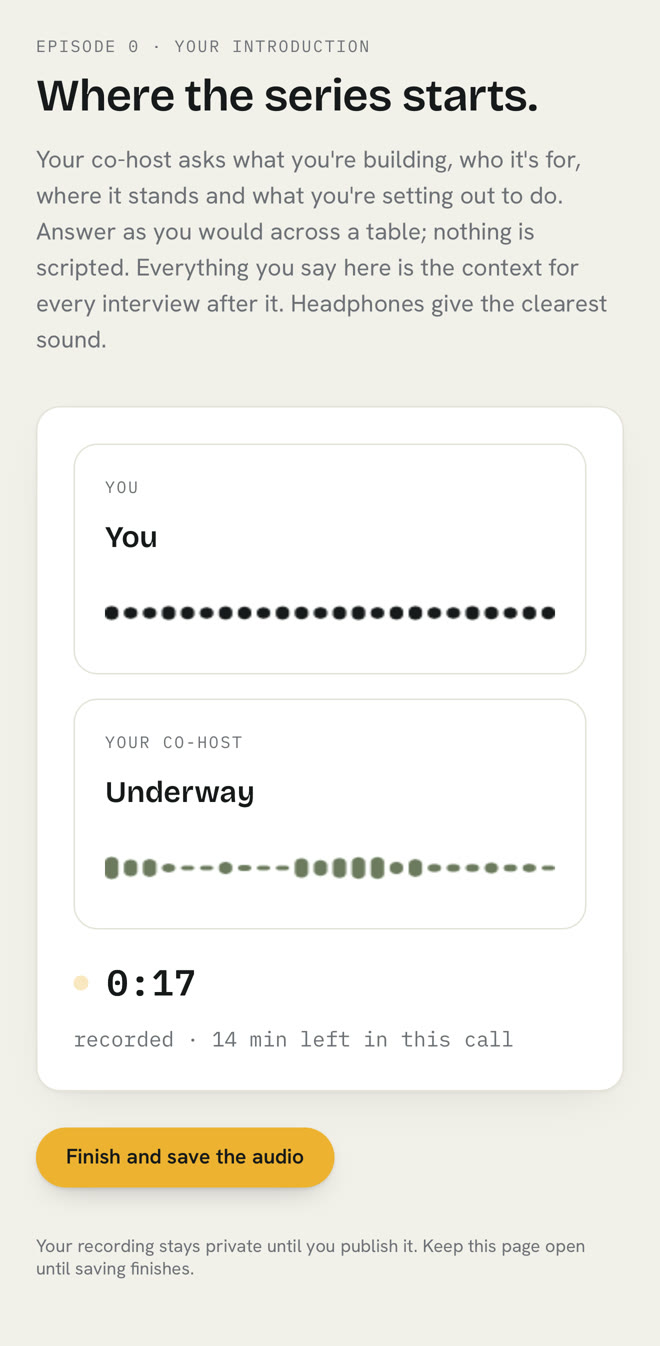
press start episode zero or practice episode zero, and the same screen opens first. on camera or just my voice is already set from what you told us, and changes in one tap. nothing asks for your camera or microphone until you press start.
- a practice first, if you want one: three minutes, with your voice and one on camera. it is deleted when it ends, nothing is kept and nothing is sent anywhere.
- the real one is up to ten minutes. your co-host opens on what you are building, from your series name and your one line, and asks you to say it in a couple of sentences.
- it works through six things as the conversation allows: what it is, who it is for, what problem it solves and what people do instead today, where it honestly stands, the hardest part, and what comes next.
- it never asks you to sell it. if an answer comes out as a pitch, say it again and the host follows.
- go back is there while it counts down and connects, and stop and go back during a practice.
- afterwards: keep this as episode zero, have another go, or delete it. later, redo episode zero is on its page in the vault.
episode zero and every go at it are free on every plan. it does not take a number: it sits at the front of your series as the place a new viewer starts, and you can publish it from share like any episode.
if your business already exists
a first video is not only for day one. someone ten years into a business has more to say here, not less. the beats are the same, but the framing changes: where it stands carries the real scale, and what comes next is this chapter, the new range, the rebrand, ten customers to a hundred, rather than the founding idea. in underway the co-host picks that framing from the one line you wrote, so there is nothing extra to set.
why the first video matters more than the next fifty
nobody arrives at episode 47 and scrolls back to the start. they need a door. a first video that says plainly who you are, what you are doing and where it stood on that day is that door, and it stays useful for as long as the channel exists.
in underway it does a second job. its transcript becomes standing context for every interview after it, so later questions start from what you said there rather than asking you to explain the product again. the hardest part you named and the goal you set become your first topics to film.
after the introduction: the second video
the second video is where most channels stall, because the introduction used up the obvious thing to say. the answer is to stop looking for topics and film what happened: what you worked on, what broke, what you decided. in underway those are numbered episodes, episode 1 and on, filmed whenever suits you, with questions asked out loud about whatever you pick, and cut, captioned and numbered for you.
if you would rather be asked who you are than write it out: an ai that interviews you.
what should i say in my first youtube video?
your name, what you are making or doing, who it is for, where it honestly stands, and what the channel will follow. then the first real thing you have to show or say.
how do i introduce myself without sounding awkward?
be asked rather than present. answer questions out loud, from a friend or an interviewer, as you would answer a person, and do one practice run you throw away.
should my first video be a channel trailer?
it can be. a short intro works as a trailer. a longer first conversation about what you are doing ages better, because new viewers can start there and hear where it began.
is episode zero posted anywhere automatically?
no. it stays in your vault until you choose to publish it from share, and you can keep it, redo it or delete it.
can i do my introduction without showing my face?
yes. episode zero can be on camera or just your voice, chosen before it starts. a face makes a series easier to recognise, but voice only is a real option.
the longer version of a founder's first video: founder intro video.
get looser on camera before you record: how to practice talking on camera.
From the series
Founders’ episodes, written up.
Every public episode on underway has a page of its own: the video, then the same account in writing, checked against what the founder actually said.
Browse every series
Building Underway
People pay more than you think to fix a problem
I changed the positioning of Underway from day-one urgency to the pain of not having posted content for years, and raised the cheapest plan from a 14-day trial at $29.99 to a seven-day trial at $129.99. Signups came in faster and the cost to acquire each one dropped a lot. That lets me start working out CAC, margins and recurring revenue, which matters after the Anthropic bill gave me a scare. I'll go through the ads I crafted in another episode.
Building Underway
Train Your Ai Clone To Make Money: part 2
I rebuilt my AI clone in Underway from three short phone recordings, then used it to set up a 12 to 15 second ad. I played back the clone video from last time, which I'd be happy to run as an ad even though the pacing at the end is off, and showed earlier attempts where the face and lighting were wrong. The model finished building while I talked through how the ads get researched and written, and the new ad I queued was still at 0% when I stopped.

Building Underway
Train Your AI Clone to Make Money
I trained my AI clone inside Underway for marketing by recording the three short clips it asks for: sat and talking, up close, and walking with my phone. I turned the voice recording off because Underway already has plenty of my voice from the episodes I've made, so it defaults to that. The walking clip was still saving when I stopped, so how the clone actually looks and how I use it to write scripts and market will be part two.

Building Underway
Meta ads setup for more app sign ups
Underway hit 20 signups, and I'm testing an AI background changer for a new studio setup. I talk about how the signups feel compared to my first big sales back when I started in sales, and why I'm documenting it to see where I am in a year's time. I'm also recording this one sitting in front of a plain wall in my kitchen that gets filled in with a background, after seeing a few people on X post videos doing the same. I don't know yet how it will come out.
Building Underway
How to screen record only one tab (for SEO traffic)
I walked through Underway's "what's worth doing now" section on the Today page, which scans my website and GitHub and suggested filming "how to screen record only one tab" to sit alongside the article I already have up, with a one-click handoff into filming the walkthrough. I also mention we got our first customer yesterday after switching the ads from join for free to entering card details with 14 days free. The hover highlight on that screen isn't working, so the black panels are hard to read, and I'm going to fix that next.

Building Underway
Getting found in AI search terms
I walked through Underway's Found in AI Answers tool, which checks the questions buyers ask ChatGPT, Claude and Gemini with web search on and reports whether the answers name you, cite your page or name a competitor instead. This week I'm named in 1 of 17 answers, cited by ChatGPT for a question about a tool that interviews you by voice and turns the answers into a podcast episode. Nine of the searches name someone else, and for each one the tool gives me a question to say out loud and answer on camera, then publishes the answer on my own site under that heading. I haven't filmed those answers yet.