
Article
document don't create: how founders actually do it
17 October 2026 · 9 min read
Post on X
document don't create is the idea that you should share what you are actually doing, as you do it, instead of trying to invent content about it. you are not making an advert or a lesson. you are keeping a record of the work, out loud, and letting people watch it happen. for a founder that means the decisions, the problems and the small wins of building the thing, told while they are still in motion.
the phrase comes from Gary Vaynerchuk, who has argued for years that most people freeze when told to make content, because making content sounds like you need to be an expert with something polished to say. documenting asks for less. you only need to say what happened and what you think about it.
most pages on this explain the idea and stop there. this one is for founders who already agree with it and still have not managed to do it for more than a week. it covers what it means, why it suits founders in particular, why it still dies, and how to make documenting nearly free.
what does document don't create mean?
creating starts from a blank page. you decide on a topic, you write a hook, you script it, you film it, you edit it, and you hope it lands. every piece is a small production, and every production asks you to be someone with answers.
documenting starts from your day. something happened, you say what it was and what you made of it, and that is the piece. you do not need to know more than your audience. you only need to be one step further along the road you are describing, and honest about where you are on it.
if you search document don't create gary vee, you will find his original post at the top, and it is worth reading. the short version is that the journey is the content. a founder who shows the work as it happens has an endless supply of material, while a founder who tries to manufacture insight runs dry in a fortnight.
why documenting suits founders
- you already have the material. every day of building a company has a decision, a problem or a customer in it. you are not looking for ideas, you are looking at what you did.
- it builds trust you cannot buy. people watch a founder make real choices over months and learn how they think. that is worth more to a customer, a hire or an investor than any polished pitch.
- it is a record you cannot make later. the day you launch, you can write about how it started, but you cannot film it. footage of the early, unfinished months only exists if someone pointed a camera at them while they were happening.
- it compounds. one entry is a diary page. sixty in order are a story people can follow from the beginning, and every new one gives the old ones a reason to be watched.
- it keeps you honest. saying out loud what you did today, and what you are doing next, has a way of showing you when the two do not line up.
why most founders still don't document
here is the part page one skips. document, don't create removes the pressure to be an expert, but it does not remove the work. documenting a day on video still means four separate jobs, and each one is a place where the habit quietly stops.
- deciding what to say. you open the front camera and your mind goes blank. a whole day happened, and none of it feels like a story. so you say "so, today was fine" and close the app.
- filming. finding the light, propping the phone, doing it again because you stumbled. ten minutes for a ninety-second answer.
- editing. cutting the ums, the false starts and the long pause while you thought, adding captions, adding a title. this is where most good recordings go to die, unwatched on a camera roll.
- posting. writing a caption for each place it goes, choosing a cover, remembering which number this one is.
add those up and documenting costs most of an hour a day. that is a creating budget. the advice was right about the mindset and silent about the overhead, and the overhead is what kills it. the fix is not more discipline. it is making each of the four jobs close to free.
document don't create, every day, without the overhead
five habits make documenting cheap enough to last. none of them needs special software, though software can do most of the work for you.
- answer a question, don't perform. a blank camera invites a presentation. a specific question about today invites an answer. "what's the state of the signup emails today?" gets a real reply that names its subject. "how did today start?" gets a shrug and a pronoun. write the question first, or have something ask it for you.
- keep it in order. do not move the best line to the front. people who follow a build come back to find out what happened next, not to be hooked. chronology is what makes it read as a diary rather than an advert.
- count episodes, not days. call it episode 47, not day 47. you will miss days, and a day count either shows the gap to everyone or lies about it. an episode count is honest whatever happens, and the next one is simply the next number.
- choose your own pace and protect it. once a day, whenever suits you, is a good rhythm, but the commitment should be yours: weekdays, every day, or three a week. a holiday should pause the chain, not break it.
- record in private if you need to. if you are in stealth, or not ready to show it, document anyway and publish later. the footage of this stage is the part you cannot recreate, so keep filming and decide about publishing when the time comes.

creating content vs documenting
the difference is easiest to see side by side. neither is wrong. a founder who makes tutorials is creating, and that can work well. the point is that documenting asks far less of you on a day when you have nothing to teach.
| creating content | documenting | |
|---|---|---|
| what you start from | a blank page and a topic you have to choose | what you did today |
| what you need to know | enough to teach it | only what happened and what you think |
| time it takes | an idea, a script, a shoot and an edit per piece | the length of your answer, if the editing is done for you |
| what it sounds like | a presentation, written for strangers | a person telling you about their day |
| on a quiet day | nothing to post | a short entry about what stalled, which is still the story |
| what it adds up to | a pile of separate posts | a numbered series someone can watch from the start |
a worked example: one episode, start to finish
underway was built to take the four jobs off a founder's plate, so that documenting costs only the talking. its own founder documents building it, and every episode of that series is public, in order. here is what one entry looks like.
- pick what it is about. the setup offers topics from your series so far and from your day, read from tools you connect, such as GitHub and your calendar, or you type one line in your own words. say you spent today on the signup emails.
- answer. the app asks one question out loud for each thing you picked, and the question stays on screen. you answer for as long as it takes. there is no countdown, and it ends after the last question. on a day off camera, the audio interview does the same by voice.
- get on with your day. the answers are cut into a numbered episode while you do something else: your episode card at the front, the ums and false starts out, captions on, in the order you said things. nothing is trimmed to hit a length and nothing is reordered.
- post, or don't. the episode comes with the words for each place it might go, YouTube, LinkedIn, TikTok, Instagram, X and the rest, written from what you said, plus short vertical clips. every series starts private, so you can keep it in your vault for as long as you like.
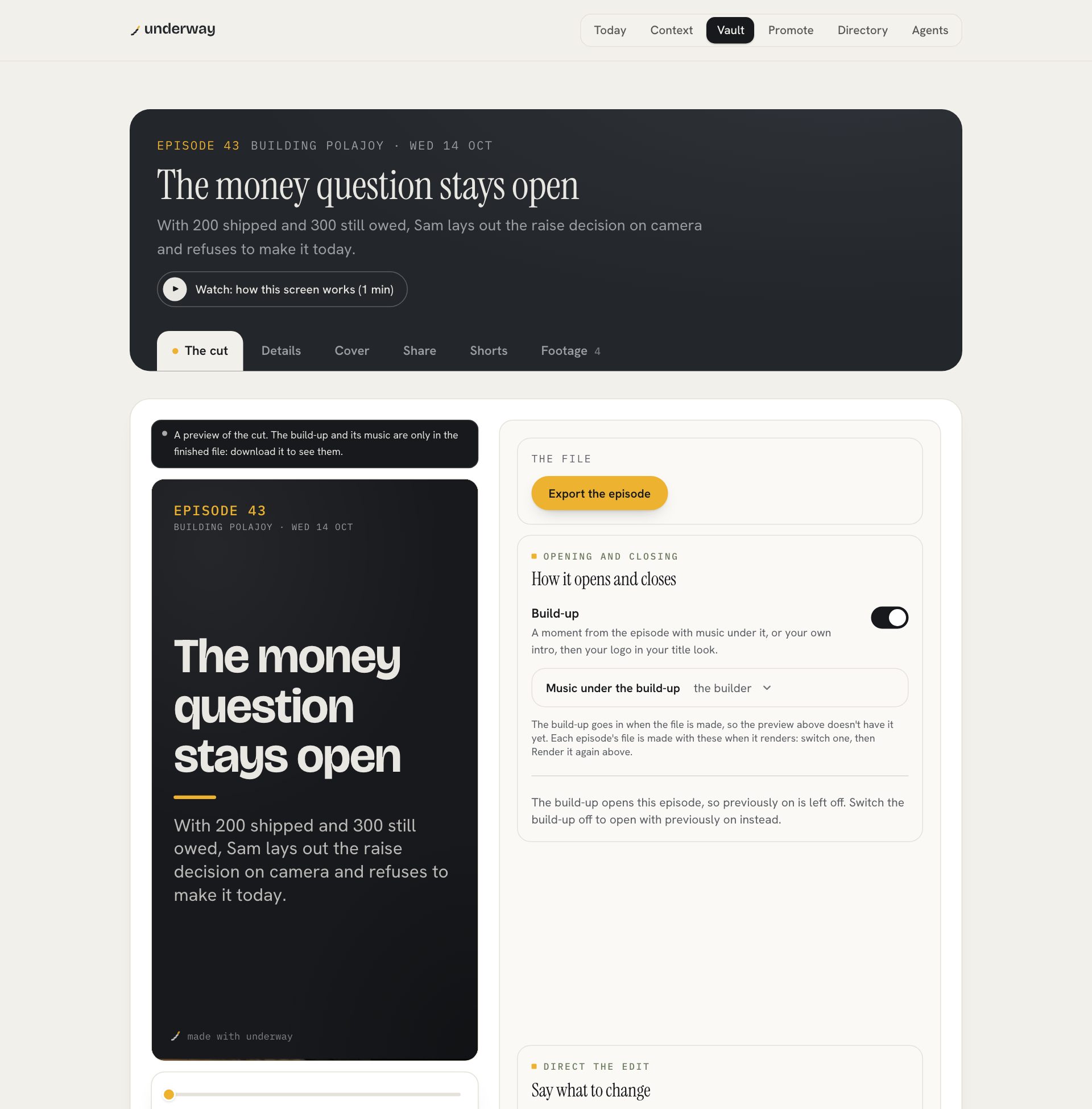
before the first daily entry comes episode zero: what you are building, who it is for, where it honestly stands and what you are setting out to do. every interview after it reads it, along with what you said in earlier episodes, so the questions get sharper rather than asking you to explain the basics again.
for a stealth founder, the vault is the point. you film exactly as you would in public, and nothing leaves the app. on any paid plan, the day you go public can release the whole vault at once, oldest first, with episode zero as the place to start and every filming date kept. the origin story is already on camera, in order, in your own voice.

to judge the result rather than our description of it, watch Building Underway, every episode in order.
what it costs
documenting by hand costs nothing but time, and if you have the time, a phone and a notes app are enough. underway starts with a 14-day free trial of Founder: you add a card at the start and nothing is charged until day 15. Founder is $29 a month after that, and Series, which adds posting to every connected network in one tap and the week in one cut, is $79 a month.
documenting is the base of founder-led content: the founder's own voice, showing the work, as the thing that earns attention. the hub below covers the rest of it, from what to post to where.
faqs
who said document, don't create?
Gary Vaynerchuk popularised it in a post on his own site, arguing that showing your journey as it happens beats trying to produce content as an expert.
is documenting the same as building in public?
close. building in public is the decision to share how your company is going. documenting is the method: showing the work as it happens rather than writing it up afterwards.
what should i document if nothing happened today?
what stalled, what you are waiting on, or the decision you are putting off. a quiet day in a build is still part of the story, and a short entry keeps the series moving.
do i have to be on camera?
no. in underway the audio interview is voice only and counts as a numbered episode like any other. video tends to build trust faster, but a voice entry beats no entry.
how often should a founder document?
once a day, whenever suits you, is the easiest rhythm to keep, because the cue never moves. but choose a commitment you can hold, weekdays or three a week, and count episodes rather than days.
can i document in private and publish later?
yes. every underway series starts private. you can film for months in the vault and release it all, in order, the day you go public.
where to go next
the whole picture of founder-led content, and where documenting fits in it: /founder-led-content.
for the days when it feels like there is nothing to say: /what-to-post-when-nothing-happened.
if you are documenting in private and planning the day you go public: /coming-out-of-stealth-mode.
this is part of underway's guide to founder-led content: founder-led content, without the work of creating it.