
Article
building in public for small business, not just saas
30 September 2026 · 8 min read
Post on Xbuilding in public for small business: the short answer
building in public for small business means sharing the running of the business as it happens: the decisions, the customer conversations, the pricing, the hires, the suppliers, the things that broke. nothing has to ship in code. a shop, an agency, a service business or a maker has a daily story that is often easier to follow than a software changelog, because everyone understands a late delivery.
most guides to build in public are written for saas founders: mrr screenshots, feature launches, github streaks. that leaves out most businesses. this page is for the rest: what to share, what to keep private, what a daily episode looks like when the work is physical or client-facing, and how to start when the business already exists.


does building in public work for a small business?
yes, for a simple reason: people buy from people they have watched work. a customer who has seen you chase a supplier for three weeks trusts the delivery date you give them. a client who has watched you turn down the wrong project believes you when you say you're picky. that trust is what a small business sells, and it's hard to build any other way.
it is also a record. a year of short episodes about running a shop is the most honest account of that year that will ever exist, and nobody can make it afterwards. whether you post it now or keep it private until later, it's yours.
it works less well if you treat it as advertising. a daily post that is really an offer gets scrolled past. the story is the thing people come back for, and the offer lands better because they've been following it.
build in public for non technical founders: what's the daily story?
when nothing ships in code, the story is the decisions. every business makes several a day. these are the ones worth an episode:
- decisions. which product to drop, which client to take, whether to open on sundays. say what you chose and what you gave up.
- customer conversations. what someone asked for, what they complained about, why they came back. (the person stays anonymous. more on that below.)
- pricing. the price you nearly raised, the discount you stopped giving, what happened to orders after.
- hires. the first part-timer, the freelancer who didn't work out, what you learned writing the job ad.
- suppliers. the quote that came in high, the delivery that was late, the switch you're weighing up.
- what broke. the card machine, the website, the van, the process. what you did about it and what you'd change.
- the numbers you're comfortable sharing. orders this week, how many clients, a target. only if you want to. a story works without them.
the structure is the same whatever you sell: where it started, what you worked on, the problem, how it resolved (or didn't), and what happens next. that skeleton is shaped by the day, not the trade. it works for a café as well as it works for an engineer.
building in public for small business: examples by trade
here is what one ordinary day looks like as an episode for five kinds of business. none of them needs a product launch.
| an ordinary day | the episode | what makes people come back | |
|---|---|---|---|
| a shop | a supplier says the next batch is two weeks late | what you're telling customers who ordered, and the backup you're weighing | does the batch arrive, and did anyone cancel? |
| an agency | you turned down a project that paid well | why it was the wrong fit, and what it cost to say no | did the kind of client you want show up? |
| a service business | a regular client asked for a discount | what you said, and why | did they stay? |
| a maker | the new glaze cracked in the kiln again | what you tried, what you think it is, what's next | does the next firing work? |
| ten customers to a hundred | three new customers, all from the same referral | who referred them and whether you can repeat it | is there a channel here, or was it luck? |
every one of those ends on an open question. that is the serial part. people following a build aren't waiting for a hook. they want to know what happened next, and a small business generates "what happened next" every day.

what not to share when building in public as a small business
building in public doesn't mean building without walls. a small business holds other people's information, and a daily habit makes it easy to say too much on a tired day. keep these out:
- customer data. names, addresses, order details, anything that identifies someone who didn't agree to be in your story. "a customer asked" is enough.
- client work under agreement. an agency's best stories are often covered by an nda. talk about your side of it: the decision, the process, what you learned.
- supplier terms. prices, margins and contract terms your supplier gave you in confidence. "the quote came in higher than we planned" tells the story without the number.
- staff matters. hiring is a good story. someone's performance, pay or health is not yours to tell.
- anything you'd regret your competitor reading. strategy you haven't committed to can wait until you have.
the safety net is a gap between recording and publishing. in underway every episode is private until you choose to publish it. on the web you can open the cut and strike any line, down to the word, and the next render leaves it out. any episode can be held back in the vault for good. so a slip on camera is a line to strike, not a post to delete.
episode 0 for a business that already exists
most build in public advice assumes you're starting from nothing. plenty of small businesses are years in. the answer is not to film an origin story. start with the current chapter.
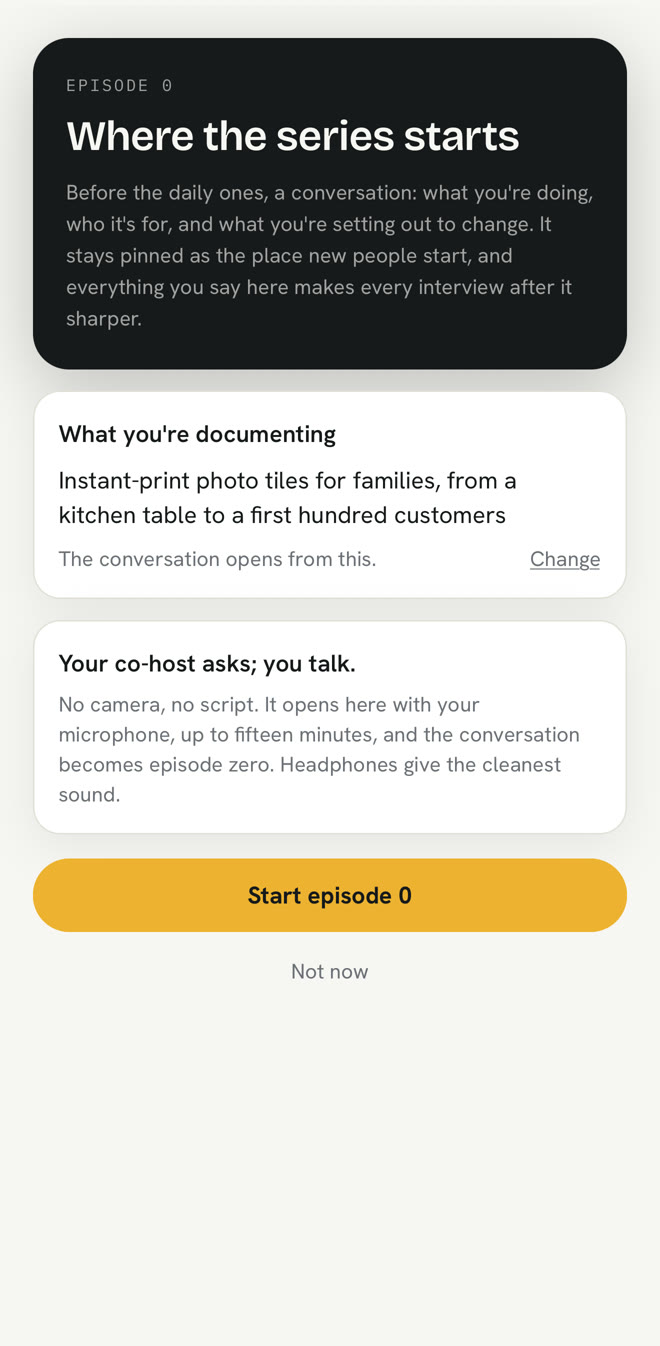
underway opens every series with an episode 0: a conversation before the first daily episode, pinned as the place new viewers start. it covers the same six beats for everyone: what it is, who it's for, what problem it solves and what those people do instead today, where it honestly stands right now, the hardest part, and what you're setting out to do by when.
for an existing business, "where it stands" is real: eight years, two staff, a shop and a website. "what you're setting out to do" is this season, not the founding idea: the second location, the move from custom work to a product, ten customers to a hundred. you write one line about what you're documenting, and the questions are generated from it. there is no picker of business types, because a shop and an agency need different questions and one sentence in your words tells it more than a category would.
how to start building in public for a small business
- pick one place first. instagram or tiktok if your customers are local or visual, linkedin if you sell to businesses, youtube if people search for what you do. more places later.
- choose a rhythm you can keep. weekdays, or three a week. a small business has busy days nobody plans for.
- record one thread per episode. the supplier, or the price, or the hire. not all three.
- keep the setup identical. same spot, same frame. nobody returns for the lighting.
- decide your walls before day one. write down what's off limits so a tired day doesn't decide for you.
- record now, publish when ready. there is no rule that says you post on the day you film.
where underway fits
the hard part of building in public for a small business isn't willingness. it's the daily overhead: deciding what to say, setting up, filming, editing, after a day on your feet. underway is a founder diary that interviews you. once a day, whenever suits you, it asks out loud, one question at a time, and you answer for about three minutes, on camera or voice only. a few minutes later there's a numbered episode with a card and captions, and the text for each platform written from what you said.
the questions come from your day. forward the supplier's email to your own underway address and it becomes one line the interview can ask about. connect your calendar or stripe and it knows about the meeting and the payment. none of it needs you to be technical, and all of it is read-only.
three episodes are free, no card. founder is £29 a month. for a chapter of a company that already exists and should stay private by default, there is founder's record at £990 a year.
what is building in public for a small business?
sharing the running of the business as it happens: decisions, customer conversations, pricing, hires, suppliers and what broke, in short regular posts or episodes. it builds trust with customers because they watch the work, not just the result.
can non technical founders build in public?
yes. the story is the decisions, not the code. a supplier who's late or a price you're about to change is easier for most people to follow than a feature launch.
what should a small business never share in public?
customer data, client work under agreement, supplier prices and terms, and staff matters. tell the story from your side: "a customer asked", "the quote came in high".
my business is years old. is it too late to build in public?
no. start with the current chapter, not the origin: where it honestly stands now and what you're setting out to do this season. that's what underway's episode 0 asks a business that already exists.
how often should a small business post when building in public?
as often as you can keep up. weekdays is a good default, and three a week is fine. a rhythm you keep beats a daily target you miss.
where to go next
for how often to post, and how to set a rhythm you'll keep, read how often to post when building in public.
for questions that work whatever your business sells, see questions to answer on camera about your business.
and if you'd rather record now and publish later, read about coming out of stealth mode.